

Lorem ipsum dolor sit amet, consectetur adipiscing elit. Ut elit tellus, luctus nec ullamcorper mattis, pulvin
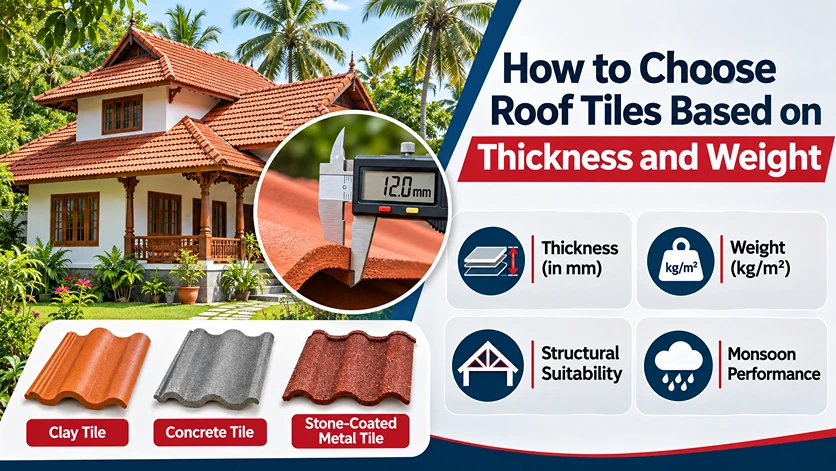
Choosing the right roof tile thickness is an important part of planning a safe and long-lasting roof. But thickness alone does not tell you whether a tile is suitable for your home.
A thicker tile may weigh more, while a thinner tile made from a different material may perform well when installed correctly. Roof tile weight also affects the rafters, beams, trusses, and other parts of the supporting structure.
For homeowners in Kerala, the choice deserves extra care. Heavy monsoon rain, humid conditions, strong winds in exposed locations, and year-round heat place different demands on a roof.
This guide explains how thickness and weight relate, how to compare clay, ceramic, concrete, and metal roofing products, and what to check before making a purchase.
ar dapibus leo.
Why Roof Tile Thickness and Weight Matter in Kerala
A suitable Kerala roof tile must match the supporting structure, approved roof slope, fastening system, and expected weather exposure.
Roofing tiles form the outer covering of a building. Their job is to shed rainwater, resist expected weather exposure, and protect the layers below.
However, they also place a permanent load on the building.
That load is known as dead load: the weight of materials that remain attached to the structure.
When choosing roofing materials, homeowners should consider:
- The thickness and shape of each tile.
- The installed weight of the tile covering.
- The condition and capacity of the roof structure.
- The roof slope and water drainage design.
- The fixing method and wind exposure.
- The cost of installation and future repairs.
For example, a tiled roof on a newly designed villa in Kochi may accommodate a different covering from an older tiled house in Thrissur.
The difference is not simply the age of the building. It is the condition, design, and verified load capacity of its roof structure.
Important trade-off: A heavier tile is not automatically more durable, and a lighter tile is not automatically more suitable for every roof.
What Is the Right Roof Tile Thickness?
There is no single ideal roof tile thickness in millimetres that applies to every material, profile, and roofing system.
Roof tile thickness refers to the distance between the upper and lower surfaces of a tile at a defined measurement point.
For a flat tile, this may be relatively easy to measure.
For curved, profiled, or interlocking tiles, the thickness may vary between the main body, raised ribs, edges, and locking sections.
That is why comparing tiles using only one thickness measurement can be misleading.
Does a thicker roof tile last longer?
Not necessarily.
Durability also depends on material composition, manufacturing quality, firing or curing processes, water absorption, exposure conditions, and installation.
For instance, increasing the thickness of a poorly manufactured tile does not automatically solve problems such as cracks, weak edges, or unsuitable water absorption.
Likewise, a thinner tile engineered for a particular roofing system may be suitable when installed according to its manufacturer’s instructions.
How should you compare roof tile thickness?
Ask suppliers for:
- Nominal tile thickness in millimetres.
- Thickness measurement location.
- Tile material and profile.
- Product testing or applicable standard.
- Tile mass and installed weight.
- Recommended roof pitch and fixing method.
Architect’s note: Thickness should be treated as one product specification, not as a substitute for structural design or performance testing.
How Does Roof Tile Weight Affect Structural Safety?
Installed roof tile weight in kg/m² is more useful for structural comparison than the weight of one loose tile.
A tile’s weight matters because the supporting roof must carry the covering throughout its service life.
The National Building Code of India discusses roof loads, including permanent loads, imposed loads, and loads associated with rain and wind.
A structural designer must consider the relevant load combinations and the roof system as a whole.
Weight per tile versus weight per square metre
Two products can weigh the same per piece but cover different areas.
A smaller tile may require more pieces and greater overlap, resulting in a heavier installed covering.
For illustration, assume:
- Tile weight: 2.5 kg per tile.
- Installed coverage: 15 tiles per m².
Installed tile mass = 2.5 × 15 = 37.5 kg/m².
For a roof covering 100 m² of actual sloped surface:
Total tile mass = 37.5 × 100 = 3,750 kg.
This is an illustrative calculation, not an Asian Roof product specification or an approved roof design.
It excludes battens, underlay, ridges, accessories, fasteners, and the supporting structure. An engineer must assess the full loads.
Why roof area matters
Roof area should be measured along the sloping surfaces rather than assumed to equal the building’s floor area.
More complex roofs may also require additional tiles around valleys, hips, edges, and other details.
Read our roof tile quantity calculation guide before preparing a purchase estimate.
Clay, Ceramic, Concrete and Metal Roof Tiles Compared
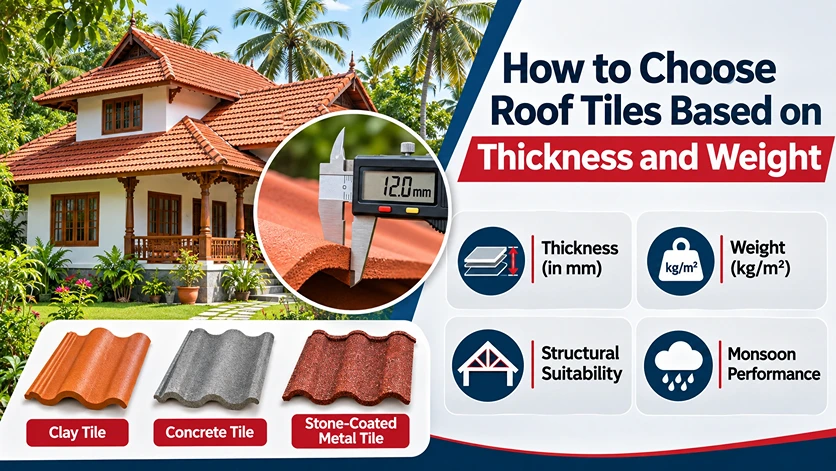
Roofing material and tile profile influence installed weight; tiles cannot be ranked reliably by thickness alone.
Different roofing products have different physical properties and installation requirements.
The following table uses published manufacturer examples to show why exact model information matters.
Roofing product | Published installed tile mass | Specification basis | Kerala selection consideration |
Marley Hawkins plain clay tile | 64 kg/m² | 100 mm gauge | Heavier example; structural suitability must be checked |
Marley Anglia interlocking concrete tile | 47 kg/m² | 75 mm headlap | Profile and overlap influence installed mass |
Marley Anglia interlocking concrete tile | 51 kg/m² | 100 mm headlap | Increased overlap changes covering mass |
Marley concrete plain tile | 73.8 kg/m² | 100 mm gauge | Different profile produces a different load |
Stone-coated metal roofing | Model-specific | Supplier data required | Consider for projects where lower covering mass is important |
The table demonstrates an important point: the same concrete tile can have a different installed mass when its required overlap changes.
Clay roof tiles
Clay roof tiles are associated with traditional Kerala architecture, particularly sloped roofs and heritage-style homes.
Advantages include a natural appearance, established roofing methods, and the ability to replace individual tiles in compatible systems.
However, the weight, water absorption, and strength of a clay tile should be assessed from its product information.
Ceramic roof tiles
Ceramic roofing products are available in different finishes and profiles.
Depending on the manufacturing process, ceramic tiles may have surface finishes that appeal to contemporary homes.
A glazed finish should not be treated as proof of structural strength, low water absorption, or a particular service life.
Concrete roof tiles
Concrete roofing tiles can provide a defined architectural profile and consistent manufactured shapes.
Their installed mass can be substantial, making structural load assessment important.
Concrete tiles should be evaluated using the manufacturer’s actual weight, dimensional tolerances, strength, and installation requirements.
Stone-coated metal roof tiles
Stone-coated metal products offer a tile-like appearance using a metal-based roofing system.
These may be worth considering for roof replacements where covering weight is a concern.
However, metal thickness alone does not establish coating performance, resistance to corrosion, thermal comfort, or rain noise.
The full system, including sheet profile, coatings, insulation, fixing details, and drainage, must be assessed.
Explore Asian Roof’s roofing collection to identify suitable product styles, then request model-specific specifications.
How Roof Tile Thickness Affects Monsoon Performance
Proper drainage, overlap, roof pitch, and fixing details are essential for monsoon performance; greater thickness alone cannot prevent leaks.
Kerala’s rainy season makes roof water management especially important.
Homeowners sometimes assume that a thicker tile will provide better protection against leaks.
In practice, rainwater can enter a roofing system through incorrectly designed overlaps, damaged flashings, blocked valleys, loose ridge details, and unsuitable roof slopes.
Key considerations
Roof pitch: The angle of the roof must meet the selected product’s approved minimum slope.
Headlap: This means the vertical overlap between rows of tiles. The correct amount depends on product design and roof pitch.
Interlocking profile: Some tile profiles are designed to control the path of water between neighbouring tiles.
Wind resistance: A tile must be fixed according to the roof’s exposure and the manufacturer’s requirements.
Water absorption: Ask for tested absorption values where relevant rather than assuming that thickness determines moisture resistance.
A coastal home near Alappuzha may require particular attention to wind exposure and fastener corrosion. A shaded hillside roof in Wayanad may face different maintenance challenges, including debris and persistent surface moisture.
For more guidance, read how roof slope affects tiled roofs in Kerala.
Common Mistakes When Choosing Roof Tiles
The most costly roofing mistakes often come from overlooking structural compatibility, installation details, and whole-roof costs.
Mistake 1: Assuming thicker means stronger
Thickness is only one factor. Ask for relevant strength test results and manufacturer recommendations.
Mistake 2: Comparing weight per piece only
Always request installed mass in kg/m² at the proposed tile overlap.
Mistake 3: Changing roof materials without structural assessment
Replacing a lightweight covering with heavier clay or concrete tiles may increase loads on existing rafters and connections.
Mistake 4: Choosing tiles only by appearance
A suitable colour or profile cannot compensate for the wrong roof pitch or fixing method.
Mistake 5: Ignoring accessories and installation expenses
The total project cost includes far more than the price per tile.
Mistake 6: Using a generic thickness rule
A recommendation for one product cannot automatically be applied to a different clay, ceramic, concrete, or metal tile.
Red flag: Be cautious if a supplier promises a universal “best thickness” without asking about your roofing structure or providing a technical data sheet.
Practical Kerala Roof Selection Example
Comparing the old and proposed installed roofing loads is a sensible first step in a tile replacement project.
Imagine a homeowner in Thrissur renovating an older house with a sloped tiled roof.
The existing roof has timber rafters, and several tiles have cracked after years of weather exposure.
The homeowner is considering replacement ceramic tiles and a stone-coated metal roofing option.
The first question might be: Which material is thicker?
A better decision process would begin with the following comparison.
Assessment | Ceramic tile option | Stone-coated metal option |
Thickness | Obtain model-specific dimensions | Obtain substrate metal thickness and coating specification |
Installed mass | Obtain kg/m² from supplier | Obtain kg/m² from supplier |
Existing structure | Engineer checks capacity | Engineer checks capacity and fixing requirements |
Rain protection | Check pitch, overlap, and flashing | Check pitch, joints, fasteners, and flashing |
Comfort | Assess complete roof assembly | Assess insulation, ventilation, and rain noise |
Budget | Include tiles, battens, accessories, labour | Include panels, fixings, accessories, labour |
This approach avoids choosing a product based on one attractive number.
A useful calculation to request
Ask the architect or engineer to determine:
Change in covering mass = Proposed covering mass − Existing covering mass
Both values must use the same roof-area basis and include the relevant permanent roofing components.
An increase in mass is not automatically unsafe. A reduction in mass does not automatically make a new roofing system safe either.
Fixings, uplift resistance, existing deterioration, and changes to load paths must all be assessed.
How homeowners can collect useful comparison data
A small field comparison can improve the decision:
- Shortlist three tile models.
- Obtain a written data sheet for each.
- Record thickness, installed mass, roof pitch, and warranty terms.
Inspect samples for visible cracks, damaged edges, and fitting quality.
- Request comparable installed quotations.
- Ask the design professional to approve the final option.
Keep the supplier documents and photographs. This creates a more dependable record than relying on verbal claims.
Roof Tile Selection Checklist for Homeowners and Architects
A written comparison of thickness, installed weight, pitch, testing, and total cost helps prevent unsuitable roofing purchases.
Checklist 1: Before selecting a tile
- Confirm the tile material and exact model.
- Request thickness in millimetres and measurement location.
- Obtain installed weight in kg/m².
- Confirm the approved roof pitch and overlap.
- Check the product’s relevant test reports or certification.
- Arrange a structural assessment where required.
- Check availability of compatible ridge and edge accessories.
Proof to keep: Product data sheet, roof drawings, supplier quotation, and structural review.
Checklist 2: Before approving installation
- Confirm the approved tile profile and finish.
- Check batten spacing and support requirements.
- Verify fixing details for expected wind exposure.
- Check valleys, flashings, gutters, and drainage.
- Confirm the installation team’s product familiarity.
- Arrange inspection of critical details before completion.
- Keep spare tiles and warranty documents where available.
Proof to keep: Installation photographs, inspection notes, invoices, and warranty paperwork.
How to compare total roofing cost
Rather than comparing only tile prices, request a full installed quotation.
Include covering materials, battens, underlay, roof accessories, transport, labour, scaffolding, waste allowance, and any structural work.
A lighter product may reduce certain load-related concerns but could require different fasteners, insulation, or detailing.
A heavier product may be appropriate for a roof designed to support it.
Neither option should be assumed to offer the lowest lifetime cost without project-specific information.
Frequently Asked Questions
❓What is the standard roof tile thickness in mm?
There is no single standard thickness for all roofing tiles. Clay, ceramic, concrete, and metal-based products use different designs and manufacturing methods. Check the specification for the exact tile model and the relevant material standard.
❓Are thicker roof tiles better?
Not always. Greater thickness does not guarantee better strength or longer service life. Material quality, testing, roof design, and correct installation are equally important.
❓How much does a roof tile weigh?
The weight varies by material, size, and profile. For structural comparisons, ask for the installed covering mass in kg/m², not just the weight of one tile.
❓Does roof tile thickness affect roof weight?
It can, especially when comparing otherwise similar tiles made from the same material. However, density, shape, dimensions, and overlap also affect weight. Thickness cannot be used alone to calculate the installed roof load.
❓Which roof tile is best for heavy rainfall in Kerala?
Choose a tile system approved for the roof’s pitch, exposure, and drainage design. Appropriate overlaps, fasteners, flashings, and installation quality are essential. No material should be selected on thickness alone.
❓Can lightweight roof tiles be installed on an old house?
They may be suitable, but the existing structure and the proposed fixing system must be assessed first. A lighter covering can still be unsuitable if the structure is damaged or if wind resistance details are inadequate.
❓What should architects check before specifying roof tiles?
Architects should review the tile’s dimensions, installed mass, tested properties, roof pitch limits, fixing instructions, accessory compatibility, and structural implications. Project-specific drawings and coordination with the engineer are important.
Choose roofing tiles by verified specifications, structural suitability, climate performance, and installation requirements—not thickness alone.
Roof tile thickness is worth checking, but it is only one part of choosing the right roofing material.
For Kerala homes, the most practical approach is to compare the actual tile model, its installed mass, the supporting structure, and the complete system’s ability to manage rain and wind.
Homeowners planning a renovation should be particularly careful when replacing one type of roof covering with another.
Asian Roof offers roofing options for different architectural styles. Browse the Roof Tiles collection and request the relevant technical specifications before confirming your choice.
A well-planned roofing decision starts with accurate information, not assumptions about thickness or weight.
Choose the Right Roof Tiles for Your Kerala Home
Not sure which roof tile thickness and weight are suitable for your home? Asian Roof offers a range of roofing options to match different architectural styles and project needs.
Explore our collection and find roofing tiles that suit your design, budget, and structural requirements.
Explore Our Roof Tiles →