

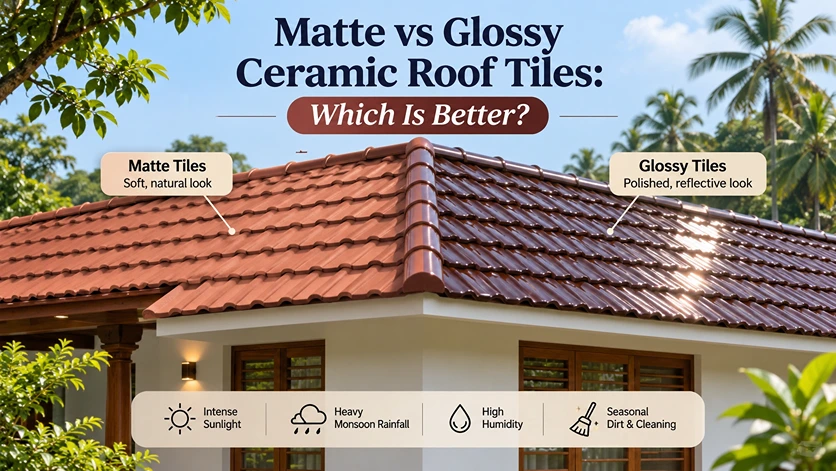
When selecting ceramic roof tiles, most homeowners notice the colour first. The second thing that catches their attention is the finish. Some tiles have a soft, natural appearance, while others have a polished surface that reflects sunlight.
But here’s an interesting detail: a roof tile that looks beautiful in a showroom may look completely different once it covers an entire house.
That’s why choosing between matte vs glossy ceramic roof tiles requires more thought than simply deciding which one looks better.
For homeowners building in Kerala, the decision becomes even more important. Roofs face intense afternoon sunlight, heavy monsoon rainfall, humidity, and seasonal dirt. The finish you select influences how your house looks and may affect cleaning requirements.
So, should you choose the understated elegance of matte tiles or the polished appearance of glossy tiles?
Let’s explore what really matters before making that decision.
The Real Difference Between Matte and Glossy Ceramic Roof Tiles
Matte and glossy ceramic roof tiles differ mainly in how their surfaces interact with visible light.
Matte ceramic roof tiles have a low-sheen surface. They create a soft, natural appearance without strong reflections. Their understated finish suits homeowners who prefer traditional or minimalist architecture.
Glossy ceramic roof tiles have a more reflective surface. Their polished appearance can make roof colours look visually prominent, particularly under direct sunlight.
However, there’s a misconception worth clearing up.
Matte does not necessarily mean unglazed, and glossy does not automatically mean higher quality. Both finishes can be produced using ceramic surface treatments.
Manufacturing quality, firing methods, coating materials, and installation standards are more important when evaluating technical performance.
| Feature | Matte Ceramic Roof Tiles | Glossy Ceramic Roof Tiles |
|---|---|---|
| Surface Appearance | Soft and natural | Smooth and polished |
| Sunlight Reflections | Usually more subdued | Can produce stronger highlights |
| Architectural Character | Traditional and minimalist | Modern and decorative |
| Surface Texture | Smooth or textured | Often smooth |
| Cleaning | Depends on texture and coating | Smooth glazes may be easier |
| Heat Performance | Depends on colour and material | Depends on colour and material |
| Durability | Product-specific | Product-specific |
| Pricing | Varies by manufacturer | Varies by manufacturer |
Why a Small Tile Sample Can Mislead Homeowners
Imagine visiting a roofing showroom and finding a glossy coffee-brown ceramic tile.
Under indoor lighting, it appears elegant. You imagine the same colour covering your new villa.
But once installed, the result may be different.
A large sloping roof contains hundreds of tiles reflecting light from slightly different angles. During certain hours, the roof may produce much stronger highlights than a single showroom sample.
Matte tiles tend to produce softer reflections, allowing the roof’s shape and colour to remain visually consistent.
This difference becomes especially noticeable on houses with large, uninterrupted roof slopes.
The distance test
Before choosing a finish, arrange several tile samples together and observe them from different distances.
A tile viewed from one metre away tells you about its texture. A group of tiles viewed from fifteen metres away gives a better idea of the overall roof appearance.
Also compare the samples under morning and afternoon sunlight.
What looks premium up close isn’t always what looks best from the street.
For homeowners building two-storey villas or houses with prominent sloping roofs, this simple observation can prevent an expensive design disappointment.
How Matte and Glossy Tiles Change the Character of a Home
Roof tiles do more than cover a building. They influence how its architecture is perceived.
A matte roof usually creates a quieter visual effect. It allows exterior walls, wooden features, windows, and landscaping to receive more attention.
A glossy roof can become a stronger design feature. Its reflective surface adds brightness and makes the roof more noticeable.
Consider three common Kerala house styles.
Traditional Kerala-style houses
Traditional houses often feature sloping roofs, verandas, wooden elements, and warm exterior colours.
Matte terracotta, earthy brown, or naturally toned ceramic tiles can complement these features without appearing overly decorative.
Glossy tiles can also work, but their reflective appearance may create a different character.
Contemporary villas
Modern villas frequently combine white walls, dark window frames, straight architectural lines, and visible roof sections.
Matte charcoal tiles can create a restrained appearance, while glossy grey or brown tiles can provide stronger contrast.
The choice depends on whether you want the roof to blend into the design or stand out.
Houses in closely built neighbourhoods
In places such as Kozhikode, Malappuram, and Kochi, neighbouring houses may stand close together.
A highly reflective roof can sometimes produce noticeable glare from certain viewing angles.
Matte tiles may be useful where softer reflections are preferred.
The important point is to evaluate the roof alongside the surrounding buildings rather than choosing its finish in isolation.
What Kerala's Monsoon Reveals About Roof Tile Finishes
During Kerala’s monsoon, roof surfaces may remain wet for long periods. Shaded areas can collect leaves, dust, and organic deposits.
This raises an important question: which finish is easier to keep clean?
Smooth glazed ceramic tiles can offer a practical advantage because dirt has fewer surface irregularities in which to settle.
Roof tile manufacturer Ludowici explains how surface texture can influence cleaning and organic growth.
However, this does not mean every glossy tile is low-maintenance or every matte tile collects dirt.
A smooth matte glaze may be easier to clean than a heavily textured finish.
The shaded-roof problem
Consider a house surrounded by coconut trees.
The front roof slope receives direct sunlight, while the rear slope remains shaded for much of the day.
Both slopes use identical tiles, yet their appearance may change differently over time.
The shaded section may remain damp for longer, creating favourable conditions for algae or moss.
This happens because of the surrounding environment, not simply because the tiles are matte or glossy.
For shaded roofs, homeowners should examine the actual surface texture, available cleaning guidance, and drainage design.
How the tiles look when wet
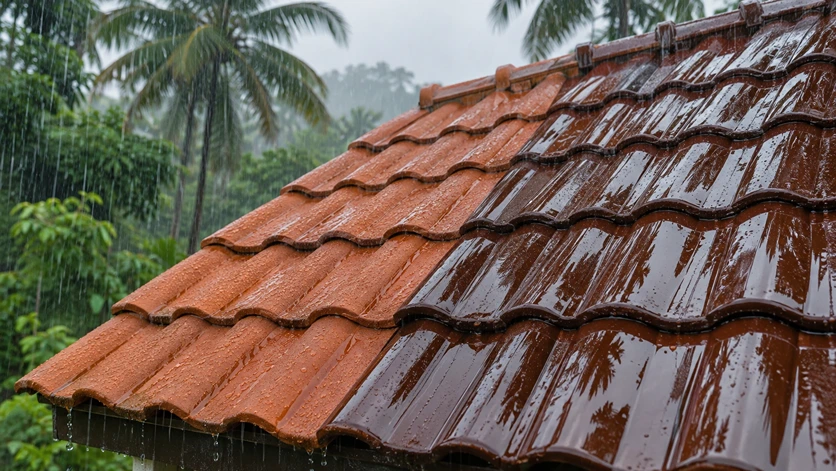
Rain may also change the visual appearance of a roof.
Some matte surfaces appear darker when wet, particularly if their texture holds a thin layer of water. Glossy surfaces may produce brighter reflections from water on the tile.
The effect varies with the coating.
A useful visual exercise is to compare small samples when dry and after lightly wetting their surfaces.
This helps homeowners understand possible appearance changes during rain, although it does not establish waterproofing performance.
Does a Glossy Roof Reflect More Heat Than a Matte Roof?
This is one of the most misunderstood differences.
Glossy surfaces can reflect visible light strongly, but that doesn’t automatically make them better at keeping buildings cool.
Roof temperature depends on factors such as solar reflectance, thermal emittance, tile colour, and the complete roof structure.
Solar reflectance describes how much sunlight a material reflects. Thermal emittance describes how effectively it releases absorbed heat.
The Cool Roof Rating Council explains why both properties matter.
A dark glossy tile may reflect visible highlights while still absorbing substantial solar energy.
Meanwhile, a lighter matte tile may reflect more total solar energy, depending on the product.
What matters for Kerala homes?
If your house has bedrooms directly beneath a sloping roof, consider more than the surface finish.
Roof ventilation, insulation, ceiling design, and colour all influence indoor comfort.
For example, a ventilated roof system with suitable insulation may offer better comfort than a poorly designed roof chosen only for its glossy finish.
Ask suppliers whether tested solar reflectance or Solar Reflectance Index information is available.
If heat control is your priority, read this guide on choosing roof tiles for hot weather in Kerala.
The takeaway: A shiny roof is not necessarily a cool roof.
Can the Finish Affect Roof Leakage During Heavy Rain?
A common assumption is that glossy tiles provide better rain protection because their surfaces look smoother.
But a glossy finish alone does not make a roof leakproof.
Both matte and glossy ceramic tiles can perform well during heavy rainfall when the roofing system is properly designed.
Water protection depends on several components working together.
These include the tile profile, overlapping joints, roof slope, ridge details, flashing, underlay where required, and drainage.
Imagine a roof with expensive glossy ceramic tiles but poorly fitted ridge pieces.
During wind-driven rainfall, water may enter through vulnerable joints despite the tiles having a high-quality surface coating.
A correctly installed matte tile system can perform better in that situation.
Why roof slope matters
Different ceramic tile profiles have different minimum installation slopes.
A slope suitable for one tile model may not be suitable for another.
Before construction, check the selected manufacturer’s installation requirements.
You can also review suitable roof slopes for tiled homes in Kerala.
For rain protection, prioritise the complete roof system rather than the finish alone.
The Overlooked Problem of Matching Roof Tiles Years Later
Here’s a question few homeowners ask while choosing tiles:
What happens if you need to replace a damaged tile five years after installation?
You may find a replacement tile with the same colour name, but its shade could differ slightly from the existing roof.
Different manufacturing batches can have natural colour variations. Years of weather exposure may also affect how the older roof looks.
These concerns apply to both matte and glossy tiles.
Manufacturer Wienerberger’s guidance on roof tile finishes discusses natural colour variations and the importance of considering batches.
In addition to colour, the replacement must match the tile’s profile, dimensions, and locking details.
A visually similar tile is not necessarily compatible.
Before buying, record the exact product name, colour code, profile, and batch information.
Ask whether spare tiles should be stored for future repairs.
This is especially useful when selecting unusual colours or less commonly available tile profiles.
Are Glossy Ceramic Roof Tiles Worth the Extra Price?
Some premium glossy tiles may cost more because of their coatings, manufacturing processes, or product positioning.
However, glossy tiles are not universally more expensive.
Specialty matte finishes can also command premium prices.
The smarter way to compare costs is to examine the complete roofing quotation.
A roof installation may include main tiles, ridge pieces, hip tiles, fixing accessories, underlay, transport, and labour.
A simple cost example
Suppose two technically suitable products are being compared for a roof covering 150 square metres.
The glossy option costs ₹120 more per square metre than the matte option.
The additional material cost would be:
150 m² × ₹120/m² = ₹18,000
This is an illustrative calculation, not a current supplier quotation.
Before paying that difference, ask what the additional amount provides.
Is it simply a preferred appearance? Does the product offer a different coating? Are there better documented specifications or warranty terms?
If the only difference is appearance, the premium is a personal design decision.
If the higher-priced product also provides verified performance benefits, it deserves a closer comparison.
Price alone cannot establish which finish offers better long-term value.
The Five-View Test for Choosing Ceramic Roof Tiles
Instead of relying entirely on catalogues, homeowners can use a simple five-view method.
This is a practical visual comparison, not a laboratory performance test.
View 1: Direct sunlight
Place matte and glossy samples outdoors and compare the intensity of their reflections.
Notice whether the glossy surface creates highlights that you find attractive or distracting.
View 2: Shaded conditions
Move the samples into shade.
Some finishes may appear much darker or less vibrant without direct sunlight.
This matters if your house is surrounded by trees or nearby buildings.
View 3: Wet appearance
Lightly wet the samples and observe the appearance.
Do they become noticeably darker? Does water create strong reflections?
Remember that this is an appearance check only.
View 4: Viewing distance
Arrange several tiles together and observe them from a distance.
A roof is experienced as a large surface, not an individual tile.
View 5: Exterior colour compatibility
Compare the tiles against your chosen wall paint, window-frame colour, and other exterior materials.
A glossy roof may complement a minimal exterior, while matte tiles may work better with more detailed architecture.
Neither result is guaranteed. The purpose is to see which finish suits your actual design.
Which Finish Is Better for Different Kerala Home Locations?
Kerala homes do not all experience identical roofing conditions.
A house near the coastline may have different exposure from a home on a shaded inland property.
That doesn’t mean one finish is automatically required for each location.
It means different details deserve attention.
| Home Situation | What to Prioritise | Finish Consideration |
|---|---|---|
| Coastal House | Exposure, suitable materials, corrosion-resistant fixings | Either finish with appropriate specifications |
| Tree-Shaded Property | Cleaning, moisture, drainage | Smooth surfaces may help |
| Large Modern Villa | Reflections and architectural balance | Compare both in daylight |
| Traditional Sloping Roof | Natural appearance and roof profile | Matte may complement the design |
| Closely Spaced Houses | Reflected glare | Matte may reduce visible reflections |
| Hot Upper-Floor Rooms | Reflectance, insulation, ventilation | Finish alone is not decisive |
For coastal homes, pay particular attention to the suitability of metal accessories, clips, and fixings for the local exposure.
For properties with extensive tree cover, maintenance access and clear drainage may matter more than surface shine.
The better finish depends on the house’s design and its immediate surroundings.
Common Mistakes When Choosing Matte or Glossy Tiles
Even homeowners who spend time comparing roof tiles can overlook important details.
Mistake 1: Assuming glossy means premium quality
Glossy refers to the surface appearance. Product quality must be assessed separately.
Mistake 2: Choosing matte because it must be cooler
A matte finish does not guarantee better thermal performance.
Mistake 3: Ignoring the roof’s size
A highly glossy tile may look subtle as a sample but visually dominant on a large roof.
Mistake 4: Forgetting maintenance access
Even a smooth ceramic roof may need occasional inspection and cleaning.
Mistake 5: Choosing a rare tile without asking about replacements
An unusual colour or profile may be difficult to match in future.
Mistake 6: Focusing only on tile price
A complete roofing quotation should account for installation, accessories, and delivery.
Myth vs Fact
|
Myth |
Fact |
|
Glossy tiles are always cooler |
Heat performance depends on tested material properties |
|
Matte tiles have no glaze |
Matte glazed tiles are available |
|
Glossy roofs cannot leak |
Installation and drainage determine rain protection |
|
Matte tiles always get dirty faster |
Surface texture and environment matter |
|
More expensive tiles last longer |
Durability needs product-specific evidence |
Avoid making a final decision until the technical requirements and visual preferences have both been checked.
A Practical Buying Checklist for Homeowners
Choosing roof tiles becomes easier when you separate appearance from technical quality.
Checklist 1: Appearance and finish
- Compare matte and glossy samples in similar colours.
- Observe both under direct sunlight.
- Check the samples when shaded and lightly wet.
- View several tiles together from a distance.
- Match the finish with exterior walls and architectural details.
Checklist 2: Product and installation
- Confirm the exact tile model and surface coating.
- Ask for water absorption and strength specifications.
- Verify the recommended roof slope.
- Check suitable fixing and drainage requirements.
- Compare warranty coverage and replacement availability.
- Request a complete installed quotation in ₹/m².
- Keep product records and approved samples.
For roof cleaning, avoid climbing on steep, wet, or unfamiliar tiled roofs. Use a qualified professional and follow the manufacturer’s recommendations.
The Kerala roof tile maintenance checklist offers additional guidance on roof inspections and drainage.
Professional review is advised for structural loading, roof slope, fixing, and waterproofing decisions.
Frequently Asked Questions
❓Which is better for a modern villa, matte or glossy ceramic roof tiles?
Both can suit modern villas. Matte tiles create a more understated appearance, while glossy tiles provide stronger visual highlights. Consider the roof’s size, exterior colours, and surrounding buildings before deciding.
❓Are matte ceramic roof tiles more difficult to maintain?
Not necessarily. Cleaning requirements depend on the coating, texture, shade, and surrounding environment. A smooth matte glazed tile can be easier to maintain than a rougher surface.
❓Do glossy ceramic roof tiles fade over time?
Colour performance depends on the pigments, ceramic coating, manufacturing process, and exposure conditions. Glossy finishes do not automatically fade faster or slower than matte finishes. Check the manufacturer’s warranty.
❓Which roof tile finish is better for Kerala's heavy rainfall?
Both finishes can work when the roofing system is suitable for the site. Proper tile overlap, slope, flashing, underlay, and drainage are more important than visible shine.
❓Are matte roof tiles better at reducing sunlight glare?
Matte tiles generally produce softer visible reflections than glossy tiles. They may be preferable when a large roof faces neighbouring windows or when homeowners want a less reflective appearance.
❓Can I combine matte and glossy ceramic roof tiles on one house?
Yes, using different finishes on separate roof sections may be possible as a design choice. However, the tile profiles and installation requirements must be compatible. Mixing finishes without a clear plan can make the roof look visually inconsistent.
❓How should I compare the cost of matte and glossy tiles?
Compare complete installed quotations rather than the price per tile. Include main tiles, ridge pieces, accessories, delivery, labour, and warranty details.
The best ceramic roof tile finish isn’t necessarily the one that shines the most or costs the least.
Matte ceramic roof tiles suit homeowners who prefer natural colours, softer reflections, and an understated architectural style.
Glossy ceramic roof tiles suit those who want a polished appearance and may appreciate the cleaning advantages of certain smooth glazed surfaces.
For Kerala homeowners, the more important questions are whether the tiles suit the roof’s slope, whether their technical properties meet the project’s needs, and whether they can be maintained and replaced conveniently.
Take time to compare real samples, ask for specifications, and inspect completed roofing projects where possible.
A good roof should look right on the whole house, not just on a showroom display.
Still Confused Between Matte and Glossy Roof Tiles?
The right roof tiles can make a lasting difference to your home's appearance and performance. At Asian Roof, explore quality ceramic roofing options that complement your home's design and suit Kerala's climate.
Find the perfect roof tiles for your dream home!
Explore Our Roof Tile Collection →