


Kerala’s Southwest Monsoon, commonly called Edavappathy, brings repeated heavy rain and periods of strong weather from around the start of the southwest monsoon season. For tiled homes, the combination of rain, moisture, wind-blown leaves, moss, algae and occasional falling coconut fronds can expose small roof defects quickly.
A practical Kerala roof tile maintenance routine has two clear stages: before monsoon, prevent problems; after monsoon, check what changed.
This roof tile maintenance checklist covers clay tiles (Odu), Mangalore-style tiles, concrete and profile tiles, along with valleys, flashing, drainage and indoor moisture signs. It also explains which checks homeowners can do safely and when a roofer should take over.
Safety Warning: Never climb onto a wet, steep, fragile, damaged or unfamiliar tiled roof. Start inspections from the ground or another protected position.
Before Monsoon Roof Tile Maintenance Checklist
A pre-monsoon roof inspection is mainly preventive. Choose a dry day and look for defects that could become harder to manage once sustained rainfall begins.
Check cracked, broken, loose and missing tiles
View every roof slope you can see safely. On traditional Kerala homes, clay roof tiles are commonly referred to as Odu or Naadan Odu.
Look for:
- cracked tiles
- broken corners or edges
- loose or shifted tiles
- missing tiles
- tiles sitting unusually high or low
- uneven rows that suggest movement
A small crack does not prove that a leak has started, but a damaged or displaced tile can leave the layers below more exposed to wind-driven rain.
If a coconut frond or branch has recently fallen onto the roof, inspect that area carefully from a safe viewpoint even when the damage is not obvious from indoors.
Inspect ridge and hip tiles
Check the tiles along the top ridge and sloping hip lines for cracks, gaps, displaced sections or loose pieces.
These exposed areas can receive significant wind and rain. If sections have visibly moved, arrange repair before prolonged rainfall rather than waiting for an indoor leak.
Check flashing, valleys and wall junctions
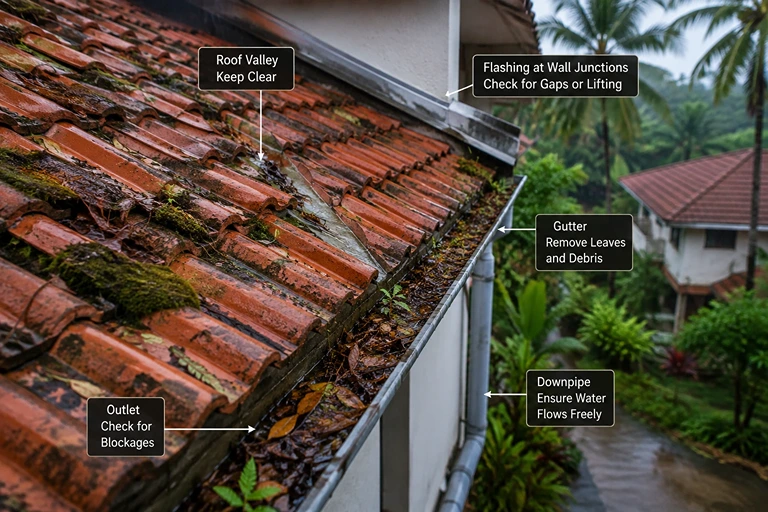
Roof valleys collect water from adjoining slopes, so they need an open path towards the gutter. Flashing protects vulnerable junctions around walls, chimneys, pipes and other penetrations.
Look for:
- lifted or bent flashing
- open joints
- debris collecting in valleys
- visible gaps where tiled roofs meet walls
- deterioration around parapet junctions
On some Kerala job sites, contractors may use local terms such as paanal for particular sheet-metal, flashing or valley details, or paanikadavu for certain junction details. Usage can vary between districts and contractors, so confirm the exact component being discussed rather than relying only on the local name.
Clear gutters, valleys, outlets and downpipes
Leaves, twigs, coconut leaf fragments, moss and silt can restrict drainage.
Before heavy monsoon rain:
- clear safely accessible gutters
- remove visible debris from valleys
- check outlets for blockage
- confirm downpipes discharge freely
- arrange professional cleaning where access requires climbing
Good drainage is one of the most practical steps in monsoon roof leak prevention. A roof does not need to look spotless; rainwater simply needs a clear route off it.
Pro Tip: During the first strong rain after cleaning, observe gutter flow from ground level. Overflow can reveal a blockage that was not obvious during a dry inspection.
Check moss and algae around drainage paths
Moss and algae are common concerns on shaded roofs in Kerala’s humid conditions. Their presence does not automatically mean roof failure.
Pay closer attention where growth:
- traps leaves or other debris
- blocks an outlet or valley
- interferes with water flow
- builds heavily around tile joints
Functional maintenance comes before cosmetic cleaning.
Look indoors for early moisture signs
Check ceilings and safely accessible attic areas for:
- old water stains
- damp patches
- peeling or bubbling paint
- discolouration
- musty areas
- visibly damp timber or insulation
- Photograph existing marks before the monsoon. If a new stain appears later, you will have something to compare it with.
Repair functional defects before sustained rainfall
Missing tiles, badly cracked Odu, loose ridge pieces, damaged flashing and drainage blockages are better addressed before a prolonged wet spell.
Check current IMD or KSDMA rainfall and strong-wind warnings before arranging exposed outdoor maintenance. Both agencies provide Kerala-specific weather and warning information.
After Monsoon Roof Tile Maintenance Checklist
A post-monsoon roof inspection has a different purpose. Instead of asking “What might fail?”, ask “What changed during the rain and wind?”
Look for fresh movement and breakage
Compare the roof with photographs taken before monsoon.
Check for:
- newly displaced tiles
- fresh cracks
- broken tiles
- missing tiles
- changed tile alignment
- branches or storm debris on the roof
Professional roofing guidance recommends checking roofs after severe weather and beginning the assessment from ground level.
Recheck ridge, hip and flashing areas
Look for new gaps or movement around:
- ridge tiles
- hip tiles
- roof-to-wall junctions
- parapets
- valley flashing
- other penetrations
If a previously straight ridge now looks irregular or a flashing edge has lifted, a closer professional inspection may be justified.
Check whether drainage has become blocked again
A gutter cleared before monsoon may be full again after weeks of rain and falling vegetation.
Inspect visible gutters, valleys, outlets and downpipes for:
- leaves
- moss
- silt
- tile fragments
- coconut debris
- other material carried by wind or water
Do not assume overflowing water automatically means the tiles are leaking. The drainage route itself may be the problem.
Look for new indoor moisture
Check for fresh:
- ceiling stains
- bubbling paint
- dampness
- discolouration
- mould-like growth
- attic moisture
- visibly wet insulation or timber
A stain may not sit directly below the entry point because water can travel along roof components before becoming visible indoors.
Compare with the pre-monsoon condition
Before-and-after photographs make roof tile maintenance in Kerala much easier to assess.
Compare the same roof slopes, ridges, valleys and indoor marks. This helps distinguish an old cosmetic issue from new storm-related movement.
Repair new defects before the next prolonged wet period
Do not leave obvious new damage simply because the main monsoon has passed. Kerala also experiences a second rainy period associated with the Northeast Monsoon, so functional repairs should not be unnecessarily delayed.
Roof Problems You Can Check Without Climbing Onto the Roof
You can identify many common problems without stepping onto the tiles.
Use ground-level viewing, phone-camera zoom, binoculars, secure balconies and upper-floor windows to look for missing tiles, uneven rows, damaged ridges, debris and visible flashing problems.
Inside, check ceilings after rain and inspect only attic areas that are safely accessible.
NRCA advises homeowners assessing storm damage to begin from ground level and leave closer roof assessment and repair to roofing professionals.
Safety Warning: Do not walk on wet, steep, fragile, damaged or unfamiliar tiled roofs. If you cannot see a suspected problem safely, call a roofing professional.
How to Clean Moss, Algae, Leaves and Roof Debris Safely
For clay roof tile cleaning in Kerala, start with one question: Is the growth affecting roof function, or only appearance?
Prioritise water flow
Leaves, moss and organic debris need attention when they block:
- valleys
- gutters
- downpipes
- outlets
- tile drainage paths
A slightly weathered roof with clear drainage can be in a better maintenance position than a spotless-looking roof with blocked gutters.
Moss does not automatically mean the roof is failing
Moss or lichen alone does not prove there is a leak.
Cleaning becomes more relevant when growth traps debris, restricts drainage or interferes with roof components. Avoid treating every green patch as an emergency.
Do not pressure wash every tiled roof
High-pressure washing is not a universal cleaning method.
Marley specifically advises against pressure washing clay tiles and warns that high-powered washing can damage tiles; its guidance for concrete tiles gives similar cautions.
Aggressive scraping can also damage certain glazed, ceramic or weathered tile surfaces.
Identify the tile manufacturer and profile before choosing chemicals, brushes or washing methods. Cleaning advice for one tile should not automatically be applied to another.
Roof Tile Maintenance by Tile Type
| Tile Type | What to Check | Main Maintenance Caution |
|---|---|---|
| Clay / Mangalore tiles (Odu) | Cracks, broken edges, movement, laps, ridge areas and missing tiles | Avoid unnecessary foot traffic; use compatible replacement tiles |
| Glazed or ceramic clay tiles | Cracks, surface damage, loose fittings and drainage areas | Avoid abrasive cleaning unless permitted by the manufacturer |
| Concrete roof tiles | Cracks, displaced pieces and moss around drainage routes | Do not assume pressure washing is safe |
| Interlocking/profile tiles | Seating, alignment, interlocks and damaged profiles | Similar colour does not guarantee a correct fit |
For older Kerala tiled homes, replacement compatibility matters. A tile that looks almost identical may have a different profile, lap or locking detail.
For Mangalore tiles in particular, the Bureau of Indian Standards lists IS 712, a code of practice specifically relating to roofing with Mangalore tiles. This is an industry reference rather than a Kerala homeowner inspection law.
DIY Roof Inspection vs Professional Roof Inspection
Homeowners can usually:
- inspect visually from safe locations
- photograph roof condition
- monitor ceiling stains
- check safely accessible attic spaces
- record where and when moisture appears
Professional assessment is recommended for:
- repeated leaks
- multiple displaced tiles
- loose or falling tiles
- damaged ridge or hip sections
- damaged flashing or valley details
- structural sagging
- wet structural timber
- suspected underlay or waterproofing damage
- difficult roof access
- repairs requiring work at height
The decision is less about whether a repair appears “small” and more about whether it can be inspected and completed safely.
Common Roof Maintenance Mistakes During Kerala Monsoon
1. Waiting until water starts dripping indoors
A drip may appear after the problem has developed further. Staining, dampness, movement or blocked drainage can provide earlier clues.
2. Walking on wet roof tiles
Wet Odu or glazed tiles can be slippery, and unsuitable foot traffic may also damage tiles. Inspect from a safe position instead.
3. Pressure washing every stained roof
Staining is not a reason to use the strongest cleaning method. Follow the tile manufacturer’s guidance.
4. Replacing tiles based only on colour
Colour is only one factor. Profile, size, overlap and interlocking details determine whether a replacement tile will work correctly.
5. Cleaning tiles while ignoring drainage
Clearing a stained roof surface while leaving a blocked valley or downpipe does little for roof leak prevention.
6. Assuming every patch of moss means roof failure
Moss may need management where it affects drainage, but it does not automatically mean that the tiles or waterproofing have failed.
Quick Before-and-After Monsoon Checklist
| Before Monsoon | After Monsoon |
|---|---|
| Check cracked, loose, broken or missing tiles | Look for fresh cracks, missing tiles or new movement |
| Inspect ridge, hip, flashing and wall junctions | Compare these areas with pre-monsoon condition |
| Clear valleys, gutters, outlets and downpipes | Check whether drainage is blocked again |
| Check moss and debris affecting water flow | Remove new storm debris where safely accessible |
| Inspect ceilings and accessible attic areas | Look for fresh stains, dampness or bubbling paint |
| Take reference photographs | Compare with the earlier photographs |
| Repair functional defects | Repair new damage before the next wet period |
FAQs
❓How often should roof tiles be inspected in Kerala?
A practical schedule is a check before the main monsoon and another after the wet season, plus an additional visual check after severe weather. General NRCA guidance recommends roof-system inspection at least twice yearly and after significant weather events.
❓Should I inspect my roof immediately after heavy rain?
You can check the roof from ground level and look for moisture indoors. Do not climb onto wet tiles. If close inspection is required, wait for safe conditions and check IMD or KSDMA warnings before arranging outdoor work.
❓Can one cracked tile cause a roof leak?
A cracked tile can increase exposure to rain, but leaks may also involve flashing, valleys, wall junctions, underlay or other roof components. The most visible defect is not always the only source.
❓Should moss be removed from every roof tile?
No. Prioritise removal where moss traps debris or restricts drainage. Cosmetic growth alone does not automatically indicate roof failure.
❓Can I pressure wash clay or concrete roof tiles?
Do not treat pressure washing as the default. Manufacturer guidance may specifically advise against it because high-pressure water can damage tiles or drive water and debris into the roof system.
❓When should I call a professional roofer?
Arrange professional assessment for repeated leaks, several displaced tiles, loose ridge pieces, damaged flashing, structural movement, suspected waterproofing problems or any situation requiring unsafe roof access.
Effective Kerala roof tile maintenance does not require homeowners to climb across the roof or aggressively clean every stain.
Focus on the basics: inspect before monsoon, compare conditions afterwards, keep rainwater routes clear and repair functional defects early. Give particular attention to clay Odu, ridge and hip areas, valleys, flashing, parapet junctions and indoor signs of moisture.
During Edavappathy and other heavy-rain periods, use IMD and KSDMA warnings to choose a safe time for outdoor inspection or repair.
If you notice cracked or shifted Odu, recurring roof leaks, damaged ridge or valley areas, or tiles that no longer match or sit correctly, contact Asian Roof for a professional roof assessment. The team can help identify suitable replacement roofing materials, assess installation-related issues and recommend appropriate roofing or waterproofing solutions for the existing roof.
Get Your Roof Monsoon-Ready
Noticed cracked Odu, shifted tiles, or roof leaks? Contact Asian Roof for a professional roof assessment and compatible replacement tile solutions.
Request a Roof Inspection →
7 Roof Tile Installation Mistakes That Cause Leakage - AsianRoof | Premium Roofing Tiles & Solutions In Perinthalmanna
[…] your home already has a tiled roof, Asian Roof’s Kerala roof tile maintenance checklist for before and after monsoon provides additional inspection points for existing […]