
A roof colour that looks perfect in a showroom can feel completely different once it covers a large Kerala home. Strong sunlight can wash colours out, monsoon weather can make stains more visible, and the wrong roof tone can fight with your walls, stone or timber finishes.
For most homeowners, the best roof tile colours for modern Kerala homes are:
The right choice depends on your architecture, exterior palette, surrounding landscape, maintenance expectations and roofing system.
If you are planning a modern Kerala house exterior design, start with the whole elevation rather than the roof in isolation. A good roof colour should connect naturally with the walls, windows, fixed materials and garden while still looking balanced in Kerala’s bright outdoor light.
Charcoal Grey
Charcoal grey roof tiles are one of the safest choices for contemporary Kerala houses. They give a sloping roof a clean outline without looking as severe as pure black.
They work especially well with:
Best fit: Contemporary villas, minimalist homes and houses combining modern geometry with sloping roofs.
Trade-off: If the walls, windows, stone and roof are all dark, the elevation can feel too heavy. Charcoal usually works best when paired with at least one large light surface.
Terracotta
Terracotta roof tiles in Kerala remain popular for a reason. Their warm, earthy colour sits naturally beside tropical greenery, laterite, timber and warm exterior paints.
Terracotta does not have to look traditional. A muted shade can work beautifully on a modern villa with simple lines and large windows.
Good combinations include:
Best fit: Tropical homes, traditional-modern houses and contemporary villas with warm exterior finishes.
Trade-off: Bright orange-red terracotta can dominate a simple modern elevation. Softer, earthier shades are usually easier to coordinate.
Coffee Brown
Coffee brown roof tiles are a good option when charcoal feels too cool and terracotta feels too red.
They pair naturally with:
If your home has warm beige walls and timber finishes, coffee brown often feels calm and balanced.
Best fit: Warm contemporary villas and homes with prominent wood or stone details.
Trade-off: Too many brown finishes can make the exterior feel flat. Use light walls, contrasting stone or greenery to create separation.
Black
Black roof tiles create the strongest contrast, especially on white contemporary houses.
They work well with:
Best fit: Minimalist and high-contrast contemporary homes.
Trade-off: Black can make dust, pale marks and slight colour differences more noticeable. It is also important not to assume that a dark roof’s thermal behaviour can be judged by colour alone.
Muted Red
Muted red gives you some of the familiar character of a Kerala tiled roof without the brightness of traditional orange-red.
It combines well with:
Best fit: Traditional-modern homes, renovations and villas with prominent sloping roofs.
Trade-off: Muted red can be harder to combine with strongly cool grey or blue-grey exterior palettes.
Earthy Natural Shades
Clay brown, burnt earth and mixed natural colours work particularly well on houses designed to blend into their surroundings.
Consider them if the property includes:
These are especially effective roof colours for tropical homes, where the roof is intended to sit comfortably within the landscape.
Best fit: Tropical villas, garden-focused homes and stone-and-timber houses.
Trade-off: Natural colour variation can be difficult to judge from a single tile. Ask to see several tiles together or view a completed roof.
The easiest way to create good Kerala house paint and roof tile combinations is to look at undertones.
Warm colours include cream, beige, brown, red and yellow-based finishes.
Cool colours include grey, blue-grey and black.
White and many natural stones can work with either, depending on their undertone.
Exterior Finish | Recommended Roof Colour Starting Point |
White walls | Charcoal grey, black or terracotta |
Warm white | Coffee brown, terracotta or muted red |
Cream | Coffee brown or muted terracotta |
Beige | Terracotta, earthy brown or coffee brown |
Pale grey | Charcoal grey or black |
Grey stone | Charcoal grey or neutral brown |
Laterite | Terracotta, muted red or coffee brown |
Warm natural stone | Coffee brown or earthy shades |
Timber + white | Charcoal grey |
Timber + cream | Coffee brown or terracotta |
These are starting points, not fixed rules.
White + charcoal gives a crisp, modern look. White + terracotta feels warmer and more tropical. Cream + coffee brown creates a softer villa-style palette.
Laterite deserves special attention. It already brings strong red-brown tones into the façade, so terracotta, muted red and coffee brown often feel more connected to the overall design.
Timber has a similar effect. Even on a mostly white home, wood adds warmth. That can make both charcoal and earthy brown work, depending on whether you want contrast or a softer appearance.
When reviewing exterior wall and roof colour combinations, also look at window frames, paving, boundary walls and landscaping. They all affect how the roof is perceived.
Yes, but colour is only one part of roof heat performance.
In simple terms, darker surfaces often absorb more solar energy than highly reflective surfaces. But the roof that looks lighter is not automatically the roof that will keep a house coolest.
A useful measure is Solar Reflectance Index, or SRI. SRI combines how much sunlight a surface reflects with how effectively it releases absorbed heat. In general, a higher SRI indicates a surface that stays cooler under solar exposure than a lower-SRI surface under comparable conditions. The U.S. Department of Energy describes SRI as a metric based on solar reflectance and thermal emittance, while India’s Bureau of Energy Efficiency also identifies these two properties as important to cool-roof performance.
For homeowners, the practical lesson is straightforward:
Do not choose a roof only by asking whether the tile is light or dark. Ask about the actual roofing product and the complete roof construction.
Indoor comfort can also depend on:
If you are comparing clay vs concrete roof tiles for heat, the same principle applies. Material type and colour alone do not tell you the full thermal story. Product-specific reflectance, emittance and roof-system details matter more than broad assumptions.
BEE guidance defines a cool roof through high solar reflectance and thermal emittance rather than appearance alone.
So if keeping upper floors comfortable is a priority, ask your architect or roofing supplier for relevant technical data before making the final decision.
No roof colour is maintenance-free, but some shades are more visually forgiving.
Good starting options include:
These mid-tones often make everyday dust and small colour variations less obvious than very pale or very dark uniform finishes.
Pure black can make pale dust or mineral marks easier to notice. Very light roofing may show darker organic staining more clearly.
Highly uniform glossy finishes can also make a replacement tile stand out if its colour is slightly different from the original batch.
Tree cover matters as well. A roof beneath coconut, mango or other mature trees may receive more shade, leaves and moisture than an exposed roof.
If long-term appearance matters, consider weather-proof roof tile colours as part of a wider maintenance decision rather than assuming a particular colour will stay visually unchanged.
The safest approach is to choose a shade that will still look natural after normal exposure and routine maintenance.
Indoor lighting changes colour perception. A grey may look almost black, while terracotta can appear duller or brighter than it will outside.
Always view physical samples in daylight.
Wall paint can change. Roof tiles, stone, timber and window frames are usually longer-term design choices.
Pick a roof colour that can still work if the house is repainted later.
A charcoal or black roof can look excellent. But pairing it with dark walls, black frames and dark stone can leave the façade without enough contrast.
Let one or two dark elements do the visual work.
Colour names are not universal.
One charcoal may have a blue undertone. Another may be nearly black. Terracotta can range from orange-red to muted brown.
Always judge the actual tile.
A distinctive colour may be difficult to match years later.
Keep the exact product and colour details, and consider storing spare tiles from the original order.
Colour provides only part of the picture. If thermal performance matters, ask for technical information about the tile and roofing system.
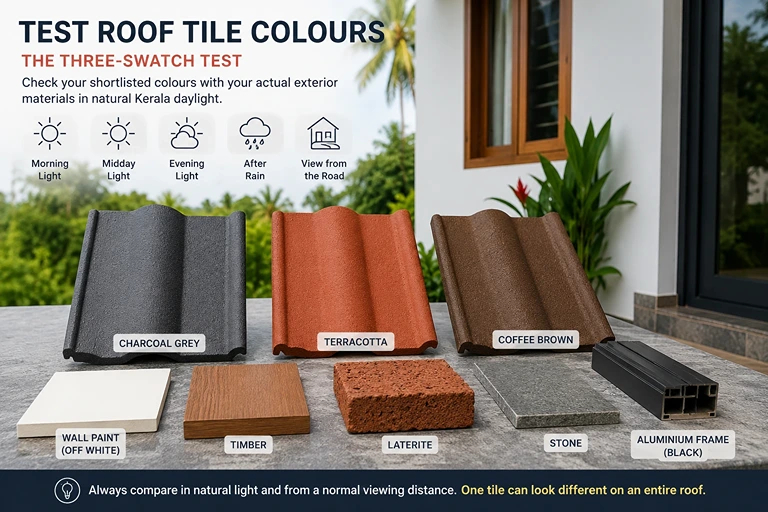
The three-swatch test is one of the easiest ways to avoid an expensive colour mistake.
That final step matters.
A roof is normally seen from several metres away, not from the distance at which you hold a showroom sample.
Kerala’s strong daylight can also change a colour through the day. A tile that appears almost black indoors may clearly read as grey outdoors. A quiet terracotta sample may feel far stronger once repeated across a broad roof.
If possible, visit a completed house that uses the same tile colour. Seeing an entire roof is far more useful than judging one individual piece.
If you have narrowed the choice to two or three colours, use the STYLE test.
S — Style
What architectural style does the house follow?
A clean white contemporary villa and a tropical laterite-and-timber home will usually need different starting palettes.
T — Tone
Are the fixed exterior materials warm, cool or neutral?
Match undertones rather than trying to make every material exactly the same colour.
Y — Years
Which option is likely to age gracefully?
Think about dust, tree cover, maintenance and whether replacement tiles may stand out later.
L — Light & Climate
How does the shade look outdoors?
Check it in real Kerala daylight, from normal viewing distances and, where possible, after rain.
E — Extras
Can matching tiles be sourced later?
Keep product names, colour details and spare tiles where practical.
The STYLE test turns a subjective question—“Which colour do I like?”—into a more useful one:
“Which colour makes the most sense for this house?”
House Style | Roof Colour Starting Point |
Contemporary white villa | Charcoal grey |
Warm modern villa | Coffee brown |
Tropical Kerala home | Terracotta |
Traditional-modern home | Muted red or terracotta |
Minimal monochrome home | Charcoal grey or black |
Stone-and-timber home | Coffee brown or earthy natural shades |
Use these suggestions to create a shortlist, not as fixed design rules.
The same charcoal roof can look completely different on two white houses if one uses cool grey stone and the other uses warm timber. Always confirm the final choice against the actual elevation.
Charcoal grey is a strong choice for contemporary white or grey homes. Terracotta and coffee brown work particularly well with warm walls, timber, laterite and natural stone. The best option is the colour that connects naturally with the complete exterior.
Yes. Charcoal grey works well with white, pale grey, stone and dark window frames. It gives a sloping roof a clean modern appearance while usually feeling softer than pure black.
Black and other dark surfaces can absorb more solar energy than highly reflective surfaces, but colour alone does not determine indoor temperature. Roof insulation, ventilation, air gaps, ceiling construction, underlay, solar reflectance and thermal emittance all contribute to overall performance.
No. Muted terracotta can look very contemporary when paired with clean architecture, warm white walls, timber, laterite or simple stone finishes. The overall elevation matters more than whether the colour has traditionally been used.
White gives you the most flexibility. Charcoal and black create stronger modern contrast, while terracotta and coffee brown produce a warmer, more tropical look. Window frames, stone and timber can help you choose between them.
Compare three physical samples beside your actual exterior finishes. Check them in morning, midday and late-afternoon light, then step back and view them from the road. If possible, also visit a completed roof in the same shade.
The best roof tile colours for modern Kerala homes are not simply the colours that look attractive in a catalogue.
The right shade should suit the complete elevation, work with your roofing system, look balanced in real Kerala daylight and remain practical to maintain and replace over time.
Shortlist a few colours. Compare them against the actual wall, stone and timber finishes. Then judge them outdoors and from the distance at which the house will normally be seen.
Not sure whether charcoal, terracotta or coffee brown is right for your home? Compare physical samples against your exterior finishes and speak with the Asian Roof team about the most suitable roofing option, colour and installation approach before finalising your roof.
Not sure which roof tile colour suits your home? Get expert guidance from the Asian Roof team.
Get a Roof Colour Consultation →