

Choosing the right roofing tiles is essential for building a strong, durable, and weather-resistant home. In Kerala, where heavy monsoon rainfall, intense sunlight, and high humidity are common, the type of roofing tile you select can make a significant difference in long-term roof performance.
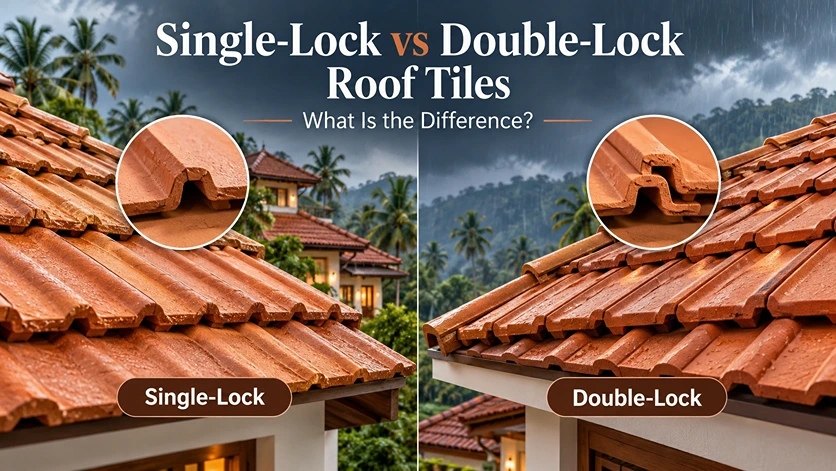
When comparing single-lock vs double-lock interlocking roof tiles, the main difference lies in their locking design. While both types are designed to connect neighbouring tiles and manage rainwater, their joint structures offer different benefits.
Understanding these differences can help homeowners choose roofing tiles that suit their roof design, local weather conditions, and budget.
What Are Single-Lock and Double-Lock Interlocking Roof Tiles?
Interlocking roof tiles have specially designed edges that fit together, helping tiles stay aligned while directing rainwater across the roof surface.
The two commonly discussed locking designs are single-lock and double-lock.
Single-Lock Roof Tiles
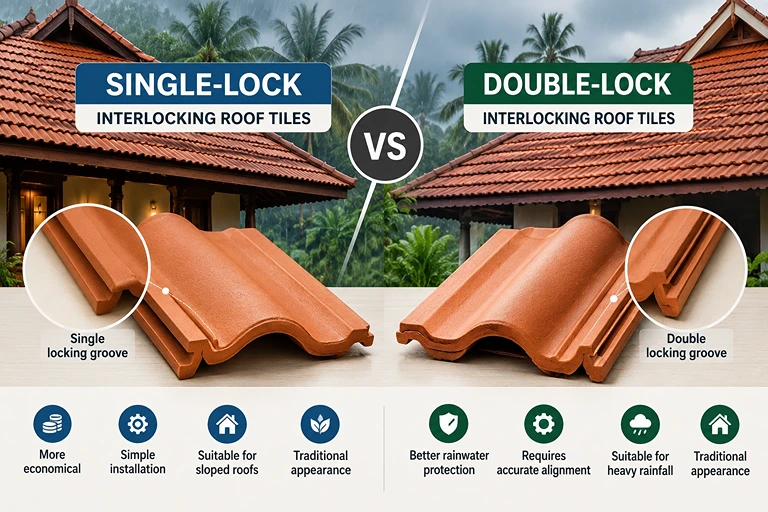
Single-lock roof tiles generally feature one main interlocking groove along their side edges. In traditional Mangalore-pattern clay roofing, they are commonly known as single-groove tiles.
Their relatively simple joint design makes them a practical option for suitable sloped roofs.
Key features:
- Simple interlocking design.
- Often more economical than comparable double-groove tiles.
- Suitable for roofs with the recommended slope.
- Traditional appearance suitable for Kerala homes.
- Can be used in selected decorative roofing applications.
Double-Lock Roof Tiles
Double-lock roof tiles, commonly called double-groove tiles in traditional clay roofing, feature an additional groove arrangement along the joining edges.
This design creates an extra barrier that may help limit rainwater entering through the joints.
Key features:
- Additional interlocking groove arrangement.
- Potentially improved resistance to water entering the side joints.
- Suitable for selected rain-exposed sloped roofs.
- Provides a traditional tiled appearance.
- Requires accurate alignment during installation.
The terms single-lock and double-lock can vary between manufacturers. Therefore, homeowners should always compare the actual tile profiles before purchasing.
Single-Lock vs Double-Lock Roof Tiles: Key Differences
Although both types serve the same basic roofing purpose, their performance characteristics can differ.
| Feature | Single-Lock Roof Tiles | Double-Lock Roof Tiles |
|---|---|---|
| Locking Mechanism | One main groove | Additional groove arrangement |
| Rainwater Protection | Depends on installation | May provide extra joint protection |
| Installation | Simpler joint structure | Requires accurate alignment |
| Cost | Often more affordable | May have a higher initial cost |
| Roof Slope | Depends on tile specifications | Depends on tile specifications |
| Suitable Applications | Compatible sloped and decorative roofs | Selected rain-exposed sloped roofs |
| Maintenance | Regular inspection required | Regular inspection required |
The most important difference is how the interlocking joints manage water.
Double-groove tiles may provide additional resistance to rainwater entering between neighbouring tiles. However, this advantage depends on the actual tile design, roof slope, overlap, and installation quality.
A double-lock tile does not automatically guarantee better performance in every roofing application.
Which Roof Tile Is Better for Kerala's Heavy Rainfall?
Kerala experiences significant rainfall during the southwest and northeast monsoon seasons. During heavy rain, roofing systems must allow water to flow away quickly while reducing the risk of leakage.
This makes roof tile selection particularly important for houses in areas such as Malappuram, Perinthalmanna, Thrissur, Kochi, and Kozhikode.
Single-Lock Tiles During Monsoon
Single-lock tiles can perform well when installed with the correct slope, overlap, and fixing methods.
However, their simpler joint design may provide less resistance to water entering the side joints than a suitably designed double-groove tile.
Double-Lock Tiles During Monsoon
Double-lock tiles may offer additional protection because their extra grooves create a more complex path for rainwater entering the joints.
This can be useful for roofs exposed to heavy rainfall and wind-driven rain.
However, even double-lock tiles can experience leakage if the roof has incorrect overlaps, damaged tiles, poor drainage, or unsuitable installation methods.
Kerala roofing tip: For homes exposed to heavy monsoon rain, consider the complete roofing system, including roof slope, gutters, drainage channels, and tile fixing—not just the locking mechanism.
With over 40 years of roofing experience, ASIANROOF emphasizes choosing roofing materials based on Kerala’s climate, roof structure, and long-term maintenance requirements.
How Does Roof Slope Affect Interlocking Roof Tiles?
Roof slope plays a major role in the performance of both single-lock and double-lock roofing tiles.
The roof slope, also called roof pitch, is the angle at which the roof rises from a horizontal surface. It determines how rainwater flows towards the gutters and drainage outlets.
A properly designed roof slope helps prevent water from remaining around tile joints.
For many residential tiled roofs in Kerala, a slope around 25°–35° may be considered during initial planning. However, this is not a universal requirement, and the correct slope depends on the selected tile model.
Even double-lock tiles can experience leakage if installed below the manufacturer’s recommended minimum pitch.
Other important factors include:
- Correct overlap between tile rows.
- Proper ridge and valley construction.
- Suitable waterproof underlay where required.
- Clear gutters and drainage outlets.
- Secure tile fixing.
For a detailed explanation, read what roof slope is suitable for tiled roofs in Kerala.
Do Double-Lock Roof Tiles Reduce Heat Better?
Many Kerala homeowners choose clay and other roofing tiles because they want comfortable indoor temperatures during hot weather.
However, double-lock tiles do not necessarily provide better heat protection than single-lock tiles.
The locking mechanism mainly influences how tiles connect and manage rainwater. Heat protection depends on other roofing characteristics.
These include:
- Roofing material: Clay, concrete, and ceramic roofing products have different thermal properties.
- Roof colour: Lighter surfaces generally absorb less sunlight than darker surfaces.
- Ventilation: Proper airflow beneath the roof can help reduce heat buildup.
- Insulation: Suitable insulation helps limit heat entering the living space.
For example, a well-ventilated clay-tiled roof may provide better indoor comfort than a poorly ventilated roof, regardless of its locking design.
Myth: Double-lock roof tiles always keep homes cooler.
Fact: Roof ventilation, insulation, material, and overall construction play a greater role in heat control than the number of locking grooves.
Which Roofing Tile Is More Cost-Effective?
Cost is another important factor when comparing single-lock and double-lock roof tiles.
Single-lock tiles are often more economical because they have a simpler profile. Double-lock tiles may cost more depending on their design, manufacturing process, and specifications.
However, homeowners should not compare roofing options based only on the price of individual tiles.
The total roofing cost depends on:
- Tile size and quantity.
- Roof area and slope.
- Supporting framework.
- Installation labour.
- Fixing accessories and ridge tiles.
- Transport and maintenance requirements.
For a roof with high rainfall exposure, a suitable double-lock tile may justify the additional initial expense.
For other correctly designed roofing systems, single-lock tiles may provide a more economical solution.
Practical advice: Request quotations for the complete roofing system rather than comparing only the price per tile.
Common Mistakes to Avoid When Choosing Interlocking Roof Tiles
Even good-quality tiles may develop problems if the roofing system is poorly designed or installed.
Here are some common mistakes homeowners should avoid.
- Choosing tiles only by appearance
Both single-lock and double-lock tiles can provide an attractive traditional look. However, appearance alone does not indicate rainwater resistance.
- Ignoring the recommended roof slope
Different roofing tile models have different pitch requirements. Choosing the wrong slope can increase leakage risks.
- Assuming double-lock tiles are completely waterproof
Additional grooves may improve joint protection, but no locking mechanism guarantees a completely waterproof roof.
- Overlooking drainage arrangements
Blocked gutters, poorly designed valleys, and inadequate drainage can cause water buildup during heavy rainfall.
- Ignoring installation quality
Incorrect tile alignment, inadequate fixing, and improper overlap can affect the performance of either tile type.
To understand these problems in greater detail, explore common roof tile installation mistakes that cause leakage.
How to Choose the Right Roof Tiles for Your Kerala Home
The right choice between single-lock and double-lock tiles depends on the requirements of your roofing project.
For example, consider two common situations.
Traditional Sloped Roof Exposed to Heavy Rain
For a house with a sloped roof exposed to regular monsoon rainfall, a suitable double-groove tile may be worth considering because of its additional joint protection.
However, correct roof slope, fixing, overlap, and drainage are still essential.
Decorative Roofing Over Waterproofed Concrete
For decorative roofing installed above a properly waterproofed concrete roof, a compatible single-groove tile may offer a practical and economical solution.
In this situation, the underlying waterproofing system provides separate protection against water entry.
These examples illustrate how different roof conditions can influence tile selection.
Before Purchasing Roof Tiles
- Compare the actual locking designs.
- Check the manufacturer’s recommended roof slope.
- Confirm tile quality, size, and weight.
- Compare complete installation costs.
Before Installation
- Confirm correct tile alignment and overlap.
- Check gutters and drainage arrangements.
- Follow the recommended fixing method.
- Ensure the roof structure can support the selected tiles.
When planning a new roof, it is also helpful to understand the different roof tiles commonly used in Kerala houses.
Frequently Asked Questions
❓Which is better: single-lock or double-lock roof tiles?
Lorem ipsum dolor sit amet, consectetur adipiscing elit. Ut elit tellus, luctus nec ullamcorper mattis, pulvinar dapibus leo.
❓Are double-lock roof tiles suitable for Kerala's monsoon?
Lorem ipsum dolor sit amet, consectetur adipiscing elit. Ut elit tellus, luctus nec ullamcorper mattis, pulvinar dapibus leo.
❓Are double-lock roof tiles completely waterproof?
Lorem ipsum dolor sit amet, consectetur adipiscing elit. Ut elit tellus, luctus nec ullamcorper mattis, pulvinar dapibus leo.
❓Are single-lock roof tiles cheaper than double-lock tiles?
Lorem ipsum dolor sit amet, consectetur adipiscing elit. Ut elit tellus, luctus nec ullamcorper mattis, pulvinar dapibus leo.
❓Do double-lock roof tiles reduce indoor heat?
Lorem ipsum dolor sit amet, consectetur adipiscing elit. Ut elit tellus, luctus nec ullamcorper mattis, pulvinar dapibus leo.
Both single-lock and double-lock interlocking roof tiles offer practical benefits for different roofing applications.
Single-lock tiles can be an economical and suitable choice for correctly designed roofing systems, while double-lock tiles may offer additional protection against water entering tile joints, making them worth considering for roofs exposed to Kerala’s heavy monsoon rainfall.
However, a durable roof depends on more than the number of locking grooves. Roof slope, drainage, tile quality, structural suitability, and proper installation all contribute to long-term performance.
Before making your final decision, compare the actual tile specifications and choose a roofing system that matches your home’s design, local climate, and budget.
The best roof tile is not simply the one with more locks—it is the one that works best with your complete roofing system.
Find the Right Roof Tiles for Your Kerala Home!
Not sure whether single-lock or double-lock interlocking roof tiles are the right choice? ASIANROOF helps you explore roofing options based on Kerala's climate, your roof design, and your budget.
Contact ASIANROOF ↗