

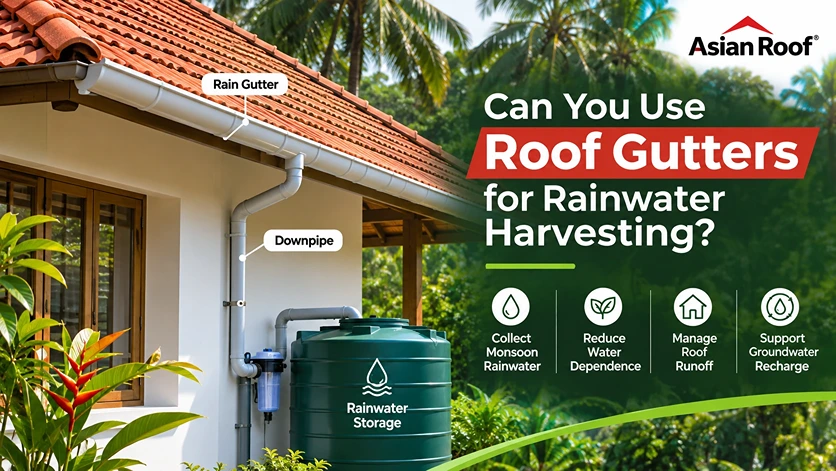
Rain gutters for rainwater harvesting offer an effective way to collect rooftop runoff and reuse it instead of allowing it to drain away from your property. In Kerala, where heavy seasonal rainfall is common, a properly designed gutter system can support water conservation while protecting buildings from uncontrolled roof runoff.
However, effective rainwater harvesting involves more than connecting a gutter to a storage tank. Gutter dimensions, roofing materials, rainfall intensity, downpipe capacity and filtration all influence how efficiently the system collects water.
For home builders and architects, incorporating rainwater harvesting into the initial roof design can improve drainage performance, reduce unnecessary modifications and support long-term water management.
This guide explains how roof gutters work for rainwater harvesting, how to select suitable materials and what technical considerations matter when designing a system for Kerala homes.
Why Use Rain Gutters for Rainwater Harvesting in Kerala?
Although Kerala receives substantial seasonal rainfall, many households experience water shortages during the summer months. Rooftop rainwater harvesting offers a practical way to supplement household water supplies by collecting and storing rainfall during the monsoon.
Without a properly designed drainage system, rainwater flowing from sloping roofs may accumulate around foundations, damage landscaping or repeatedly wet exterior walls.
Rain gutters help manage this runoff by collecting water along the roof edges and directing it towards designated drainage points.
The benefits of integrating gutters with a rainwater harvesting system include:
- Collecting rainwater for suitable household applications.
- Reducing dependence on external water supplies.
- Managing water discharge around foundations.
- Reducing soil erosion caused by uncontrolled roof runoff.
- Supporting groundwater recharge where site conditions permit.
- Improving overall residential water management.
For architects designing contemporary or traditional Kerala homes, rainwater harvesting can be incorporated without compromising the architectural appearance of the building when gutters and downpipes are planned early.
How Do Roof Gutters Work for Rainwater Harvesting?
Roof gutters act as collection channels that intercept rainwater flowing from the roof and transfer it through downpipes towards a harvesting system.
When rain falls on a sloping roof, gravity directs the water towards the lower roof edges, known as eaves. Gutters installed along these edges collect the runoff and carry it towards strategically positioned outlets.
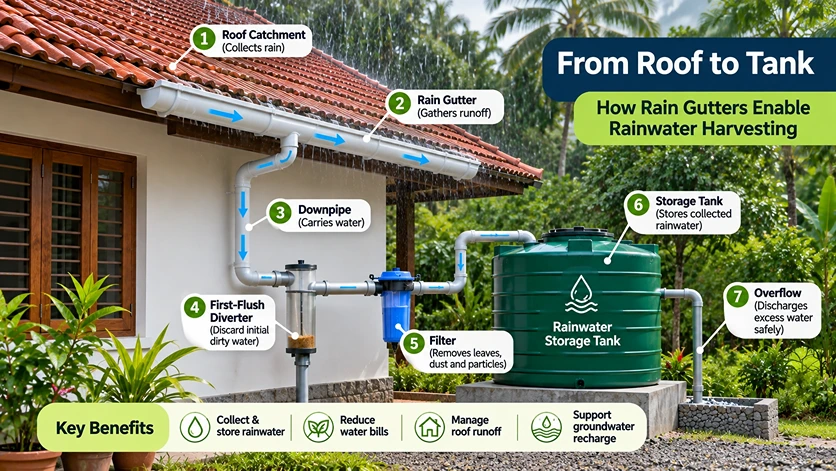
From these outlets, downpipes convey the water through screening, first-flush and filtration arrangements before it reaches a storage tank.
Roof gutter rainwater harvesting system showing the collection, filtration and storage process.
A typical rooftop rainwater harvesting system consists of the following components:
|
Component |
Function |
|
Roof catchment |
Receives and collects rainfall |
|
Rain gutters |
Capture water flowing from the roof |
|
Downpipes |
Convey collected rainwater |
|
Leaf screens |
Prevent larger debris from entering the system |
|
First-flush diverter |
Removes the initial portion of potentially contaminated runoff |
|
Rainwater filter |
Removes contaminants within its treatment capability |
|
Storage tank |
Stores harvested rainwater |
|
Overflow outlet |
Safely discharges excess water |
Roof gutters form the connection between the roof catchment and the harvesting system. Their capacity and installation quality directly influence how much runoff reaches the storage arrangement.
How Much Rainwater Can You Collect Using Roof Gutters?
The quantity of rainwater that can be collected depends primarily on the roof catchment area, rainfall depth and runoff coefficient.
The runoff coefficient represents the proportion of rainfall that becomes collectable runoff after accounting for losses associated with the catchment surface.
The potential collection volume can be estimated using the following formula:
Rainwater collection (litres) = Roof catchment area (m²) × Rainfall (mm) × Runoff coefficient
For sloping roofs, the horizontal projected roof area should generally be used for this preliminary volume calculation rather than the total inclined surface area.
Consider the following illustrative example for a residential building in Kerala.
Parameter | Estimated value |
Roof catchment area | 150 m² |
Assumed annual rainfall | 3,000 mm |
Assumed runoff coefficient | 0.85 |
Potential annual runoff | 382,500 litres |
Under these assumed conditions, the roof could generate approximately 382,500 litres of runoff annually before additional collection and storage losses.
Actual usable water will depend on gutter performance, filtration losses, storage capacity and household water demand.
Even a roof with a relatively large catchment area may collect less usable water if its gutters frequently overflow or its storage tank fills quickly during the monsoon.
How to Choose the Right Rain Gutter Size for Rainwater Harvestin
Selecting the correct gutter size is particularly important in Kerala because intense monsoon rainfall can generate large volumes of roof runoff within short periods.
A common design mistake is selecting gutters based solely on roof dimensions or annual rainfall. While annual rainfall helps estimate potential collection volume, peak rainfall intensity determines how quickly the drainage system must convey water.
Architects and builders should consider the following factors when sizing rain gutters:
- Roof catchment area served by each gutter.
- Local design rainfall intensity.
- Gutter profile and cross-sectional area.
- Gutter gradient.
- Number and position of downpipe outlets.
- Concentrated runoff from roof valleys.
- Restrictions caused by screens and filters.
Which Rain Gutter Material Is Best for Rainwater Harvesting?
Choosing the right gutter material is essential for maintaining long-term collection efficiency. In Kerala, gutters are exposed to heavy rainfall, humidity, sunlight and, in coastal regions, salt-laden air.
Different gutter materials offer different advantages in terms of durability, maintenance and installation requirements.
Gutter material | Advantages | Considerations |
uPVC gutters | Lightweight and resistant to metallic corrosion | Requires suitable UV resistance and thermal expansion allowance |
Aluminium gutters | Lightweight and suitable for various architectural designs | Finish quality and environmental exposure matter |
Galvanised steel gutters | Good mechanical strength | Protective coatings must remain in good condition |
Stainless steel gutters | Good strength and grade-dependent corrosion resistance | Generally higher initial investment |
Coated metal gutters | Available in various colours and finishes | Durability depends on coating and installation quality |
For most residential projects, material selection should balance environmental exposure, hydraulic capacity, maintenance requirements and architectural appearance.
In coastal areas such as Kochi and Alappuzha, builders should pay particular attention to the corrosion resistance of metallic gutters, brackets and fasteners. In areas with dense vegetation, accessible gutter profiles and removable debris screens can simplify maintenance.
Home builders and architects exploring rain gutters from Asian Roof should consider the roof configuration, required drainage capacity and material specifications before making a selection.
It is also important to confirm whether the gutter material and its associated coatings are suitable for the intended use of the harvested water.
How to Install Rain Gutters for Rainwater Harvesting
The performance of a rainwater harvesting system depends on both product selection and installation quality. Even appropriately sized gutters can experience leakage or overflow if installed incorrectly.
1. Assess the Roof Catchment Area
Identify the roof sections that will contribute water to the harvesting system.
For complex roofs with multiple slopes, valleys and roof levels, calculate the contributing area for each gutter section separately. Upper roof sections that discharge onto lower roofs must also be included when assessing drainage capacity.
2. Position Gutters Along the Roof Edges
Install gutters where runoff naturally leaves the roof surface.
The relationship between the roof tile edge and gutter opening is particularly important for sloping tiled roofs. Incorrect positioning may allow rainwater to overshoot the gutter or flow behind it.
3. Provide an Appropriate Gutter Gradient
Gutters should be installed with a suitable gradient towards the outlets, following the manufacturer’s installation instructions and the project’s drainage design.
Incorrect alignment can cause standing water, sediment accumulation and reduced drainage performance.
4. Install Adequate Downpipes
Downpipes should be positioned and sized to handle the expected runoff from each contributing roof section.
Long gutter runs and large catchment areas may require multiple outlets to distribute the drainage load.
5. Connect First-Flush and Filtration Components
Install appropriate screening, first-flush diversion and filtration arrangements between the roof drainage system and the storage tank.
These components should be accessible for regular cleaning and inspection.
6. Provide a Safe Overflow Arrangement
When the storage tank reaches its maximum capacity, excess rainwater must be directed towards a suitable stormwater drainage or approved groundwater recharge system.
The storage arrangement should not restrict roof drainage during heavy rainfall.
The Centre for Science and Environment provides further guidance on the essential components of rainwater harvesting systems, including gutter support and drainage arrangements.
How to Design a Monsoon-Ready Gutter System for Kerala Homes
Kerala’s residential architecture frequently incorporates sloping roofs, extended overhangs and multiple roof levels. While these features help manage rainfall, they can also create concentrated runoff at specific locations.
Roof valleys, for example, collect water from adjoining roof slopes and direct it towards a smaller section of the gutter. If this concentration is overlooked, localised overflow may occur even when the overall gutter system appears adequately sized.
Practical Design Example
Consider a hypothetical Kerala home with a total horizontal roof catchment area of 160 m².
Instead of directing the entire roof runoff towards a single outlet, the architect divides the roof into four drainage zones.
Design parameter | Illustrative value |
Total roof catchment area | 160 m² |
Number of drainage zones | 4 |
Catchment area per zone | 40 m² |
Assumed rainfall intensity | 150 mm/hour |
Assumed runoff coefficient | 0.90 |
Estimated runoff per zone | 1.5 litres/second |
Combined roof runoff | 6 litres/second |
Conceptual roof drainage plan with four catchment zones and distributed downpipe outlets.
Distributing runoff across multiple outlets can reduce the flow handled by individual downpipes and provide greater flexibility when designing the collection system.
However, the downstream connecting pipes and filtration arrangements must still accommodate the combined flow or provide a suitable bypass.
This example demonstrates a preliminary design approach rather than a final engineering specification. Actual projects require verified rainfall data, detailed hydraulic calculations and suitable product capacity information.
What Filtration Is Needed for Rainwater Collected Through Gutters?
Rainwater is not necessarily clean by the time it reaches a roof gutter. As it flows across the roof, it may collect dust, leaves, bird droppings, microorganisms and substances released from roofing materials.
A properly designed rainwater harvesting system should include suitable contamination-control measures.
Leaf Screens and Gutter Guards
Leaf screens help prevent larger debris from entering downpipes and filtration units.
They are particularly useful for Kerala homes surrounded by coconut palms, mango trees and other vegetation. However, screens must remain accessible because accumulated debris can restrict water flow during heavy rainfall.
First-Flush Diverters
A first-flush diverter redirects the initial portion of roof runoff away from the storage tank.
This helps reduce the amount of accumulated roof contaminants entering the harvested water, particularly after extended dry periods.
The required diversion volume depends on the roof catchment area, contamination levels and system design.
Rainwater Filters
Rainwater filters help remove suspended particles and other contaminants according to their treatment capabilities.
A sediment filter alone should not be considered sufficient for producing drinking water.
Covered Storage Tanks
Rainwater storage tanks should have secure covers and appropriately screened openings to reduce contamination, insect entry and mosquito breeding.
According to the CDC’s guidance on collecting rainwater safely, harvested rainwater may contain harmful microorganisms and chemicals, even when it appears clean.
Depending on water quality and local requirements, harvested rainwater can be used for applications such as toilet flushing, ornamental gardening and certain outdoor cleaning activities.
Water intended for drinking or cooking requires appropriate treatment, testing and professional assessment. Rainwater plumbing should also remain separate from drinking-water supplies to prevent cross-contamination.
Can Existing Roof Gutters Be Used for Rainwater Harvesting?
Yes. Existing roof gutters can often be connected to a rainwater harvesting system without replacing the entire roof drainage arrangement.
This can be a cost-effective option for homeowners looking to improve water management in an existing building.
However, the condition and capacity of the gutters must be assessed before making modifications.
Inspect existing gutters for:
- Cracks, leaks and damaged joints.
- Corrosion or deteriorating protective coatings.
- Loose or damaged supporting brackets.
- Inadequate gutter gradient.
- Standing water and sediment accumulation.
- Insufficient downpipe capacity.
- Frequent overflow during heavy rainfall.
- Poor alignment with the roof edges.
If the existing gutter system is in good condition and has sufficient drainage capacity, its downpipes may be redirected towards suitable filtration and storage arrangements.
However, if the gutters already experience frequent overflow during the monsoon, connecting them to a harvesting system will not resolve the underlying drainage problem.
Upgrading the gutter profile, adding outlets or replacing damaged components may be necessary before installing the harvesting system.
Common Mistakes to Avoid When Using Rain Gutters for Rainwater Harvesting
Several common design and installation mistakes can reduce collection efficiency and increase maintenance requirements.
Common mistake | Potential consequence | Recommended solution |
Selecting undersized gutters | Overflow during heavy rainfall | Calculate peak roof runoff |
Incorrect gutter positioning | Water bypasses the gutter | Coordinate gutter placement with roof edges |
Inadequate downpipe capacity | Water accumulates within gutters | Size outlets and downpipes correctly |
Ignoring roof valleys | Concentrated runoff causes overflow | Assess individual drainage zones |
Omitting first-flush diversion | More contaminants enter storage | Install a suitable diverter |
Neglecting gutter maintenance | Blockages and reduced collection | Schedule regular inspections |
Poorly designed tank overflow | Waterlogging around the property | Provide a suitable discharge route |
Using unsuitable roofing materials | Potential water contamination | Verify water-contact suitability |
Another common mistake is focusing entirely on maximising rainwater collection without considering how excess water will be managed.
During prolonged monsoon rainfall, storage tanks may reach capacity quickly. The gutter system must continue to function as an effective roof drainage system even when no additional rainwater can be stored.
Rainwater Harvesting Requirements in Kerala
Architects and home builders should review applicable building regulations when planning a rooftop rainwater harvesting system.
Kerala’s municipal and panchayat building regulations contain provisions relating to rainwater storage and groundwater recharge. Their applicability may depend on building size, occupancy, site conditions and relevant planning requirements.
Rainwater harvesting design should also consider the relevant guidance under IS 15797:2008, Roof Top Rainwater Harvesting — Guidelines, alongside applicable roof drainage provisions of the National Building Code of India.
From an architectural perspective, rainwater harvesting should be coordinated with:
- Building approval requirements.
- Roof drainage drawings.
- Underground and above-ground storage arrangements.
- Plumbing layouts.
- Site grading and stormwater drainage.
- Groundwater recharge feasibility.
- Structural requirements for storage tanks.
Homeowners planning new construction should confirm the current requirements with their municipality or grama panchayat.
Professional review is advised before finalising hydraulic designs, recharge structures or drinking-water treatment arrangements.
Rain Gutter Maintenance Tips for Efficient Rainwater Harvesting
Regular maintenance helps preserve gutter capacity, reduce contamination and minimise avoidable water loss.
In Kerala, a pre-monsoon inspection is especially important because leaves, dust and other debris can accumulate during the preceding dry months.
Pre-Monsoon Maintenance Checklist
- Remove accumulated leaves and debris from gutters.
- Inspect gutter joints for cracks and leakage.
- Check supporting brackets and fasteners.
- Confirm that downpipes are free from blockages.
- Inspect gutter alignment and drainage.
- Clean first-flush diversion components.
- Service rainwater filters.
- Inspect storage tank covers and overflow outlets.
Monsoon Maintenance Checklist
- Observe gutters for overflow during rainfall from a safe location.
- Check for water escaping behind gutter sections.
- Monitor filter and screen blockages.
- Inspect the storage tank overflow route.
- Check for standing water around the building.
- Arrange repairs if gutters sag, leak or become damaged.
Maintenance frequency should be adjusted according to rainfall exposure, surrounding vegetation and the observed condition of the system.
For additional guidance, read our Kerala roof tile maintenance checklist for the monsoon.
Roof-level cleaning and repairs should be carried out using appropriate safety equipment and trained personnel.
Are Rain Gutters for Rainwater Harvesting Worth the Investment?
For many residential projects in Kerala, installing rain gutters as part of a rainwater harvesting system can be a worthwhile investment.
Gutters serve two important purposes: managing roof drainage and directing rainwater towards productive use.
When rainwater harvesting is incorporated during the initial construction stage, builders may avoid some of the additional labour and modifications associated with retrofitting an existing drainage system.
The overall financial benefit depends on several factors, including the cost of gutter installation, storage capacity, household water consumption, alternative water supply costs and ongoing maintenance.
A larger harvesting system does not necessarily provide better financial returns. If the household has limited water demand or insufficient storage, a substantial portion of collected rainwater may still be lost through overflow.
The objective should be to design a balanced system that meets the property’s water requirements while maintaining reliable roof drainage.
Frequently Asked Questions
❓ Can you use roof gutters for rainwater harvesting?
Yes. Roof gutters collect rainfall flowing from the roof and direct it through downpipes towards filtration, storage or groundwater recharge arrangements. Correct gutter sizing and installation are essential for efficient collection.
❓Which type of rain gutter is best for rainwater harvesting?
uPVC, aluminium, stainless steel and other suitable metallic gutters can be used for rainwater harvesting. The best choice depends on rainfall intensity, environmental exposure, drainage capacity, budget and intended water use.
❓What size gutter is required for rainwater harvesting in Kerala?
The required gutter size depends on the contributing roof area, peak rainfall intensity, gutter profile, gradient and downpipe capacity. There is no single standard gutter size suitable for every residential building.
❓Can rainwater be harvested from tiled roofs?
Yes. Clay and concrete tiled roofs can serve as catchment surfaces for rainwater harvesting. The tiles should be in suitable condition, and collected runoff should undergo appropriate screening and filtration.
❓Is rainwater collected from roof gutters safe for drinking?
Not without appropriate assessment and treatment. Roof runoff may contain microorganisms, dust and chemical contaminants. Drinking-water use requires suitable treatment, water quality testing and professional guidance.
❓Can I connect existing gutters to a rainwater harvesting tank?
Yes. Existing gutters can be connected to a storage tank through suitable downpipes, first-flush diversion and filtration components. Their condition and drainage capacity should be verified before installation.
❓How often should rain gutters be cleaned in Kerala?
Gutters should be inspected and cleaned as necessary before the monsoon and checked periodically during the rainy season. Properties surrounded by trees may require more frequent maintenance.
Rain gutters are an important component of rooftop rainwater harvesting, particularly for sloping-roof homes in Kerala. They collect and convey rainfall towards filtration, storage or suitable groundwater recharge systems while helping manage uncontrolled roof runoff.
However, the effectiveness of rain gutters for rainwater harvesting depends on selecting suitable materials, calculating drainage capacity, providing adequate downpipes and maintaining the complete collection system.
For home builders and architects, the best approach is to integrate rainwater harvesting into the roof design from the beginning rather than treating it as an additional feature after construction.
Whether you are designing a new residential project or upgrading an existing roof, Asian Roof offers rain gutter solutions that you can evaluate according to your roof configuration, architectural requirements and rainwater collection needs.
A properly planned gutter system can make seasonal rainfall a useful household resource while supporting better building drainage and long-term water management.
Planning a Rainwater Harvesting System?
Choose the right rain gutters for efficient rainwater collection with Asian Roof.
Explore Rain Gutters →