

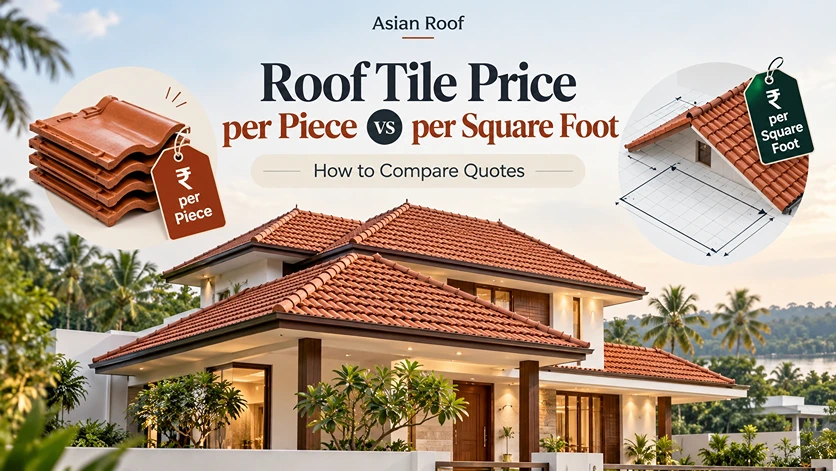
Choosing the right roofing tiles is an important decision when building a new home. Apart from design, colour, and durability, the price of roofing materials plays a major role in planning the construction budget. However, comparing roofing tile prices is not always straightforward, especially when different suppliers use different pricing methods.
Some suppliers quote the roof tile price per piece, while others provide the roof tile price per square foot. This difference can make it confusing for homeowners, architects, and contractors to identify which quotation offers better value.
For example, one roofing tile may cost ₹40 per piece, while another costs ₹60. The ₹40 tile may appear more affordable, but the actual cost depends on how many tiles are required to cover the roof. If the ₹60 tile covers a larger area, the total material cost could be lower.
Roofing expenses also depend on the roof’s design, slope, tile overlap, supporting materials, transportation, and installation charges.
Understanding these factors helps you compare quotations accurately and avoid unexpected expenses during construction.
In this guide, we explain how roofing tile pricing works, how to calculate costs, and what to check before choosing a supplier for your home in Kerala.
Understanding Roof Tile Price per Piece vs per Square Foot
Roofing suppliers generally use two methods to quote tile prices. Both are useful, but they represent different measurements.
What is roof tile price per piece?
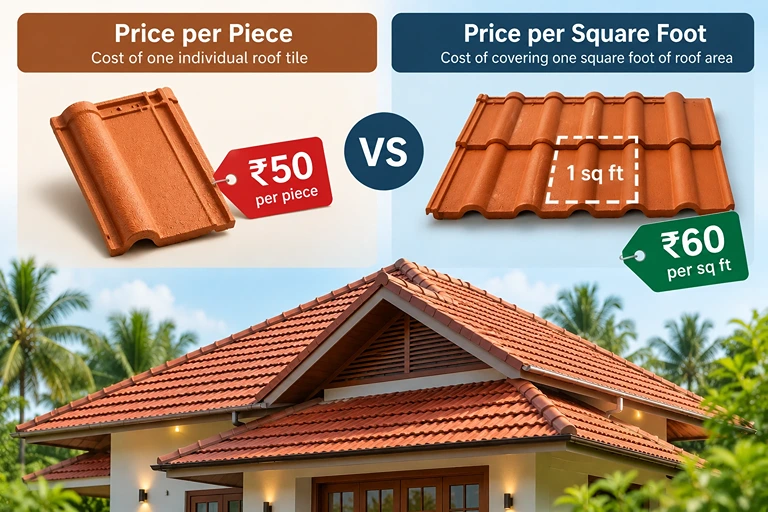
Roof tile price per piece is the amount charged for one individual roofing tile. This pricing method is commonly used for clay roof tiles, terracotta tiles, ceramic roof tiles, and concrete roof tiles.
For example, if a roofing tile costs ₹50 per piece and your project requires 1,500 tiles, the basic material cost will be:
1,500 × ₹50 = ₹75,000
This calculation is simple, but it does not show whether the tile is economical for the area it covers.
Two roofing tiles may have different dimensions, profiles, and overlap requirements. A smaller tile may require more pieces, while a larger tile may cover the same area with fewer pieces.
Therefore, the price per piece should not be the only factor when comparing roofing materials.
What is roof tile price per square foot?
Roof tile price per square foot refers to the cost of covering one square foot of roofing area.
For example, if a supplier quotes ₹80 per sq ft for roofing materials and the actual roof area is 1,000 sq ft, the estimated material cost will be:
1,000 × ₹80 = ₹80,000
The main advantage of square-foot pricing is that it allows homeowners to compare different roofing products using the same roof area.
However, not every square-foot quotation includes the same services. One supplier may include only roof tiles, while another may include accessories or installation.
Before comparing rates, confirm exactly what each quotation covers.
Which pricing method is better?
Neither pricing method is automatically cheaper.
Per-piece pricing is useful when calculating material quantities and ordering tiles. Per-square-foot pricing is more convenient when comparing the cost of covering a particular roof area.
For an accurate comparison, the best approach is to convert per-piece prices into square-foot costs and then calculate the total project expense.
The important factor is not how much one tile costs, but how much it costs to cover the entire roof properly.
How to Calculate Roof Tile Price per Square Foot
Calculating the cost of roofing tiles per square foot is easier when you know the tile’s effective coverage.
Effective coverage is the actual roof area covered by one tile after installation. Roof tiles are installed with overlaps to help manage rainwater, so their installed coverage is smaller than their full dimensions.
The basic formula is:
Roof Tile Price per Sq Ft = Price per Tile × Number of Tiles Required per Sq Ft
Let’s understand this with an example.
Suppose a particular roofing tile costs ₹55 per piece, and the installation requires 1.2 tiles per square foot.
The calculation will be:
₹55 × 1.2 = ₹66 per sq ft
If the measured roof area is 1,200 sq ft, the basic roofing tile cost will be:
1,200 × ₹66 = ₹79,200
This amount covers the main roof tiles only. Wastage, special tiles, transportation, labour, and additional materials must be calculated separately.
Why tile coverage matters
Roofing tiles come in various sizes and shapes. Some are designed to overlap heavily, while others use interlocking profiles to cover a larger area.
The manufacturer’s recommended overlap, roof pitch, and tile profile influence the number of tiles required.
For example, Marley’s technical specifications for an interlocking roof tile show that the same tile can have different coverage rates depending on its headlap, meaning the overlap between rows.
This illustrates why nominal tile dimensions alone are not enough to calculate roofing quantity.
Before purchasing, ask the supplier for the installed coverage rate of the exact tile model. This information will help you calculate both the total quantity and the material cost.
Roof Tile Price Comparison: Which Quote Offers Better Value?
Let’s consider a practical example of a homeowner planning roofing for a house in Kerala.
The actual sloped roof area is 1,000 square feet. The homeowner receives two quotations for different roofing tiles.
Tile A costs ₹40 per piece, while Tile B costs ₹60 per piece.
At first glance, Tile A appears to be the cheaper option. However, the tiles have different coverage rates.
Roof tile price comparison table
Comparison | Tile A | Tile B |
Price per piece | ₹40 | ₹60 |
Tiles required per sq ft | 1.5 | 0.9 |
Roof area | 1,000 sq ft | 1,000 sq ft |
Tiles required before wastage | 1,500 | 900 |
Material cost per sq ft | ₹60 | ₹54 |
Material cost before wastage | ₹60,000 | ₹54,000 |
Tile cost with 5% extra quantity | ₹63,000 | ₹56,700 |
Although Tile B is more expensive per piece, it provides better coverage and requires fewer tiles.
For this example, Tile B offers a saving of ₹6,300 on the main roofing tiles after including the illustrative extra quantity.
But the comparison should not stop here.
Suppose Tile B requires additional fixing accessories or more expensive installation work. Those costs might reduce or eliminate the initial saving.
This is why the final decision should consider the complete roofing quotation instead of just the tile material price.
Why cheaper tiles can sometimes cost more
A smaller roof tile may have a low purchase price, but it can require more individual pieces to cover the same roof.
That may also mean more tiles to handle, position, and fix during installation.
On the other hand, a larger tile may provide faster coverage, but it could have different handling, support, or fixing requirements.
These factors depend on the actual product and roof design.
A lower price per piece does not guarantee a lower roofing cost. Compare the installed cost per square foot before making your decision.
How Roof Area, Slope, and Design Affect Tile Quantity
One of the most common mistakes in roofing cost estimation is assuming that the house’s built-up area is equal to the roof area.
For instance, a house with a built-up area of 1,500 sq ft may have a larger roof surface because of the slope, extended eaves, verandas, and additional roofing sections.
Roof measurements should therefore be based on the actual design rather than floor area alone.
Understanding sloped roof area
Most traditional Kerala homes use sloped roofs to help rainwater drain away.
The steeper the roof, the greater its surface area compared with its horizontal projection.
For example, consider a simple roof with a horizontal projected area of 1,000 sq ft, including its overhangs.
If the roof has a uniform slope of 30 degrees, its approximate sloped area would be:
Sloped roof area = Horizontal projected area ÷ cos(roof angle)
1,000 ÷ 0.866 = approximately 1,155 sq ft
This means the actual roofing surface is larger than the horizontal projected area.
The example assumes a uniform slope. More complex roofs must be measured section by section, and the pitch adjustment should not be applied again if the measurements are already taken along the sloped surface.
Why roof design makes a difference
A simple two-sided sloped roof generally has fewer junctions and corners than a roof with multiple slopes, hips, and valleys.
Complex roofing designs may require additional cutting, ridge tiles, valley flashing, and finishing materials.
For example, a house in Malappuram with a simple sloped roof and another house with a decorative multi-level roof may have similar floor areas but different roofing material requirements.
The complex design may also require more installation time.
This does not mean homeowners should avoid attractive roofing designs. Instead, they should understand how the chosen design influences material quantities and overall expenses.
For accurate planning, use the final architectural drawings and refer to this roof tile quantity calculation guide.
Additional Costs That Can Change Your Roofing Quotation
The price of roofing tiles is only one part of the total roofing budget.
A quotation that appears affordable at first may become more expensive after including materials and services that were not mentioned in the initial rate.
Understanding these costs makes it easier to compare quotations fairly.
- Installation and labour charges
Installation costs depend on several factors, including the roofing material, roof height, slope, accessibility, and design complexity.
For example, a simple rectangular roof may be easier to install than a roof with multiple corners and decorative sections.
Some suppliers provide material-only quotations, while others include installation work.
Always confirm whether labour is included in the quoted square-foot rate.
- Ridge tiles and finishing accessories
Ridge tiles are used along roof peaks, while special accessories may be needed around hips, valleys, edges, and wall connections.
These components help complete the roofing system and manage water flow.
They may be priced separately from the main roof tiles.
A quotation that excludes these materials may initially appear cheaper but may not represent the actual project cost.
- Roof support materials
Depending on the roofing system, tiles may be installed over battens and other supporting components.
The type and spacing of these supports depend on the tile profile, structural design, and installation requirements.
Correct support spacing is important for proper overlap and secure fixing. Marley’s guidance on roof batten spacing explains how spacing relates to tile overlap and roof performance.
For a Kerala project, follow the specific product manufacturer’s instructions and the structural engineer’s design.
- Transportation and unloading charges
Transportation can also influence roofing material costs.
Delivery expenses may vary depending on the supplier’s location, the construction site’s accessibility, the order quantity, and unloading arrangements.
A homeowner purchasing tiles for a site near Perinthalmanna may receive different delivery charges from someone building in a more remote or difficult-to-access area.
When comparing quotations, check whether delivery and unloading are included.
- Wastage, cutting, and breakage
Some extra roofing tiles may be required for cutting, damaged pieces, or complex roofing details.
The appropriate allowance depends on the type of tile and the roof’s design.
A simple roof may have different wastage requirements from a roof with several valleys and angled edges.
Ask the roofing contractor to calculate the expected extra quantity rather than using an arbitrary percentage.
Ordering accurately helps reduce unnecessary expenses while avoiding material shortages during installation.
Choosing the Right Roof Tiles for Kerala Homes
When comparing roofing tile prices in Kerala, the climate and building design should be considered alongside the budget.
Kerala experiences heavy monsoon rainfall, humidity, and periods of intense sunlight. Roof tiles must be suitable for the building’s exposure conditions, slope, and supporting structure.
A roofing material that works well for one building may not be ideal for another.
Clay and terracotta roofing tiles
Clay and terracotta roofing tiles are closely associated with traditional Kerala architecture.
Their natural appearance complements sloped-roof homes, heritage buildings, verandas, and villas.
They are available in different profiles and finishes, which can influence both the tile quantity and price.
When comparing clay roof tiles, check their effective coverage, dimensions, weight, quality, and fixing requirements.
For relevant Mangalore-pattern clay roofing tiles, the Bureau of Indian Standards lists IS 654:2023 — Clay Roofing Tiles, Mangalore Pattern — Specification in its building materials reference handbook.
Architects and contractors can use applicable product standards as part of their quality review.
Concrete roofing tiles
Concrete roofing tiles are another option for sloped roofs.
They are available in different profiles and finishes, but their weight and supporting structure requirements must be considered.
A tile that appears affordable based on material price may require different support arrangements.
This makes structural suitability an important part of the cost comparison.
Ceramic and glazed roofing tiles
Ceramic and glazed roof tiles may appeal to homeowners looking for particular colours, finishes, and architectural styles.
The cost can vary depending on product quality, manufacturing method, finish, and profile.
Before choosing them, consider matching accessories, long-term maintenance needs, and replacement availability.
Stone-coated metal roofing
Stone-coated metal roofing systems provide a tile-like appearance using metal panels.
They are generally different from individual clay or concrete roof tiles in terms of panel size, weight, support, and fixing methods.
When comparing these systems with conventional tiles, use their effective installed coverage and total installation cost rather than comparing panel and tile prices directly.
Homeowners can explore different roofing materials and tile options to understand the available styles.
Price should not be the only deciding factor
A good roof should balance appearance, durability, weather protection, maintenance requirements, and affordability.
Proper slope and water drainage are particularly important during Kerala’s monsoon season. Material selection should also take account of structural loads, fixing methods, ventilation, and future repairs.
A low-cost tile may save money initially, but unsuitable specifications or poor installation can create additional expenses later.
For more guidance, read about choosing suitable roofing tiles for Kerala homes.
How Homeowners and Architects Can Compare Roofing Quotes Accurately
Comparing roofing quotations becomes easier when every supplier provides pricing for the same roof area and similar work requirements.
Homeowners often focus on the final amount, while architects and contractors also need to evaluate material specifications and installation suitability.
Both are important.
Start with the same roof measurement
Ensure that every supplier uses the same measured roof area.
Ask whether the quoted square-foot rate applies to the horizontal projected area or the actual sloped roof surface.
This distinction is important because the figures can differ significantly for pitched roofs.
Using different area measurements can make two quotations appear more or less expensive than they actually are.
Compare the exact roofing tile specifications
Do not compare tiles based only on appearance or price.
Request details about the product model, size, installed coverage, weight, recommended roof pitch, and fixing requirements.
These specifications determine how much material is required and whether the selected tile is suitable for the building.
For architects, confirming these details before finalizing the roofing structure can help avoid design changes later.
Ask for a complete cost breakdown
A useful quotation should clearly show the main tile cost, expected quantity, accessories, transport, installation labour, and applicable taxes.
Also check whether roof supports, underlay, gutters, and other necessary work are included or excluded.
Two quotations should be compared only after their work scope has been made equivalent.
Review the warranty and product availability
Warranty conditions can differ between products and suppliers.
Ask what the warranty covers and whether installation methods or maintenance requirements affect it.
It is also useful to confirm whether matching replacement tiles will be available in the future.
For homeowners, this makes maintenance easier. For architects and contractors, it helps when planning long-term building performance.
Compare the total installed cost
Once the material quantities and additional charges are clear, divide the complete comparable quotation by the actual roof area.
Total Roofing Cost per Sq Ft = Total Comparable Roofing Cost ÷ Actual Roof Area
For example, if a complete roofing quotation is ₹1,50,000 for a measured 1,200 sq ft roof:
₹1,50,000 ÷ 1,200 = ₹125 per sq ft
This figure is more useful for budget planning than the original tile price alone.
However, the calculation is meaningful only when the quotation includes all the agreed roofing work.
Common Mistakes to Avoid When Comparing Roof Tile Prices
Several common mistakes can lead to inaccurate roofing budgets.
Choosing the lowest price per piece: A cheaper tile may require more pieces to cover the roof, increasing the overall material cost.
Ignoring tile overlap: Calculating coverage using only the full tile dimensions can underestimate the quantity required.
Using floor area instead of roof area: Sloped roofs, verandas, and extensions can increase the actual roofing surface.
Comparing incomplete quotations: A material-only price should not be compared directly with a quotation that includes installation and accessories.
Overlooking transport and wastage: Small additional costs can become significant for larger roofing projects.
Selecting materials without checking suitability: Roof pitch, structural load, rainfall exposure, and fixing methods should be considered before purchase.
A careful comparison at the planning stage can reduce the risk of unexpected material purchases or changes during construction.
Frequently Asked Questions
❓Is roof tile price per piece cheaper than per square foot?
Not necessarily. Per-piece and per-square-foot pricing are different ways of measuring roofing costs. The cheaper option depends on the tile’s installed coverage, the quantity required, and additional roofing expenses. Compare both options using the same roof area.
❓How many roof tiles are required for 1,000 square feet?
The quantity depends on tile size, design, and effective coverage. For example, if a roofing tile requires 1.2 pieces per square foot, a 1,000 sq ft roof would need approximately 1,200 tiles before wastage. The final number should be calculated using the chosen product’s specifications.
❓Why do roof tile prices vary between suppliers?
Roof tile prices can vary due to material type, dimensions, manufacturing quality, finish, brand, availability, and order quantity. Transportation and included accessories can also influence quotations. Always compare products with similar specifications and complete pricing details.
❓Does roofing tile price per square foot include installation?
Not always. Some suppliers quote only the roofing material cost, while others include installation and selected accessories. Ask for an itemized quotation to understand exactly what is covered.
❓Which roofing tiles are suitable for Kerala homes?
Clay and terracotta tiles are commonly used for traditional sloped roofs in Kerala. Concrete, ceramic, and stone-coated metal roofing systems may suit other building styles and requirements. The best choice depends on roof pitch, structural capacity, climate exposure, design preference, and budget.
❓Does roof slope affect roofing tile cost?
Yes. A sloped roof generally has a larger surface area than its horizontal projection. Slope can also affect tile overlap, fixing requirements, and installation work. Accurate roofing cost calculations should use the actual roof surface area.
❓How can I avoid hidden costs in a roofing quotation?
Request a quotation that clearly lists tile quantities, accessories, installation labour, transportation, wastage allowances, applicable taxes, and exclusions. Confirm that all suppliers are quoting for the same roof area and scope of work.
Understanding roof tile price per piece vs per square foot is essential for comparing roofing quotations and planning a realistic construction budget.
While the price of an individual tile may seem like the easiest way to compare products, it does not show the complete cost of roofing a home. Tile coverage, actual roof area, design complexity, material quality, accessories, transportation, and installation all influence the final expense.
For homeowners building in Kerala, selecting suitable roofing tiles also means considering monsoon rainfall, roof slope, structural requirements, and long-term maintenance.
The best approach is to calculate the actual roofing area, compare tile coverage, request detailed quotations, and evaluate the total installed cost before deciding.
Whether you’re building a traditional Kerala home, a modern villa, or planning a roofing project as an architect or contractor, careful price comparison helps you choose materials with confidence.
If you’re planning a new roofing project, Asian Roof can help you explore suitable roofing materials and request a quotation based on your building requirements.
Planning Your Roof? Get the Right Tiles at the Right Price!
Choosing the right roofing tiles starts with understanding the actual cost. Whether you're building a new home or planning a roofing project in Kerala, Asian Roof can help you explore suitable roofing options based on your design, budget, and requirements.
Get a Free Roofing Quote Today →