

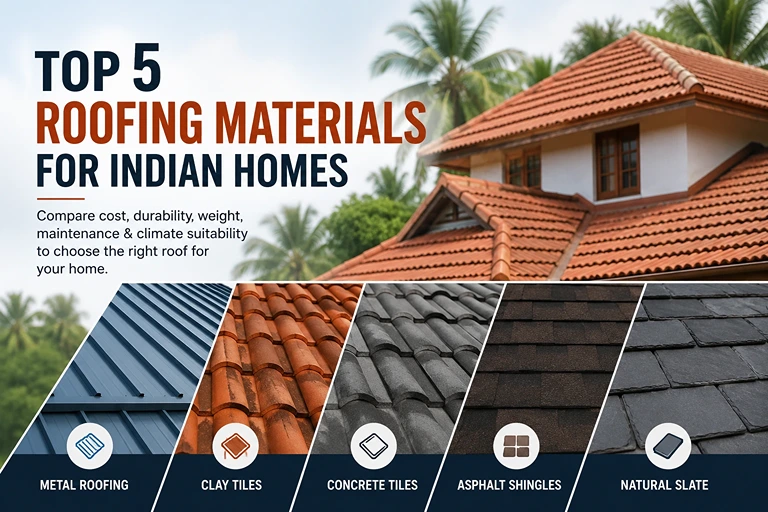
Choosing the right roofing materials for homes is not only about colour or appearance. The roof must suit the local climate, building structure, budget, maintenance needs, and quality of installation.
Five popular options for Indian homes are metal roofing, clay tiles, concrete tiles, asphalt shingles, and natural slate. Each offers a different balance of structural weight, durability, cost, design, and long-term care.
Climate is especially important in Kerala. Heavy monsoon rain, high humidity, strong sunlight, moss growth, and coastal salt exposure can affect how a roof performs. Roof slope, drainage, insulation, surface coating, and fixing quality should therefore be considered before choosing a material.
The following residential roof material comparison gives a clear starting point, followed by practical guidance for selecting the right option and comparing contractor quotations.
Quick Roofing Material Comparison
No roofing material is universally best; the right choice depends on the building, climate, budget, and complete roof system.
| Roofing Material | Relative Cost | Structural Weight | Durability | Maintenance | Climate Suitability | Best Use Case |
|---|---|---|---|---|---|---|
| Metal Roofing | Moderate | Lightweight | High with suitable specification | Low to Moderate | Good for hot, rainy, and coastal areas when correctly specified | New homes, extensions, and roof replacements |
| Clay Tiles | Moderate to High | Heavy | High | Moderate | Very suitable for hot and humid climates | Traditional villas and sloping roofs |
| Concrete Tiles | Moderate | Heavy | High | Moderate | Good for hot and rainy regions | Homes needing a uniform tiled appearance |
| Asphalt Shingles | Low to Moderate | Moderate | Moderate | Moderate | Suitable for many climates with the right roof design | Villas and homes needing design flexibility |
| Natural Slate | High | Very Heavy | Very high potential | Moderate | Suitable where the structure and installation method support it | Premium and heritage-style homes |
Actual results depend on the product specification, roof design, local climate, supporting structure, and workmanship. A correctly installed mid-range material may perform better than a premium product fitted poorly.
Metal Roofing
Metal roofing offers a practical balance of low structural weight, quicker installation, and suitability for many Indian climates.
Metal roofing includes profiled sheets, standing-seam panels, metal shingles, and stone-coated steel tiles. It is widely used in India because it is lightweight, available in many profiles, and suitable for both new construction and roof replacement.
Large sheets cover more roof area than individual tiles or shingles. This can reduce installation time and make metal a useful option for extensions, renovations, and buildings where the supporting structure cannot carry heavy materials.
Key advantages
- Lightweight compared with clay, concrete, and slate
- Suitable for modern and traditional roof designs
- Faster to install than many individual tile systems
- Available with reflective and corrosion-resistant finishes
- Practical for extensions and lightweight structures
Main limitations
Metal can sound loud during heavy rain when there is no ceiling, insulation, or sound-control layer beneath it. Thin sheets may dent, while exposed cut edges and unsuitable fasteners can increase the risk of corrosion.
Performance also varies according to sheet thickness, coating quality, fixing method, and detailing around roof edges and openings.
Best suited for
Metal roofing suits homeowners who want lower structural weight, faster installation, and manageable maintenance. It is also practical where replacement sheets, fasteners, and repair services are locally available.
Climate and installation note
For Kerala and other coastal regions, check the coating type, compatible fasteners, edge protection, and warranty conditions. Reflective finishes and suitable insulation can improve comfort during hot weather.
Clay Tiles
Clay tiles are well suited to traditional Kerala homes where natural appearance and hot-climate performance are important.
Clay tiles are a familiar feature of homes across Kerala and other parts of South India. Their natural colour, texture, and curved profiles suit villas, heritage-style buildings, resorts, and sloping-roof homes.
A well-designed clay-tile system can allow airflow beneath the roof covering, helping manage heat when combined with suitable ventilation and ceiling construction. Individual damaged tiles can also be replaced without removing a large roof section.
Key advantages
- Natural and traditional appearance
- Well suited to sloping roofs
- Good fit for hot and humid climates
- Individual tiles can be replaced
- Natural colour and texture
Main limitations
Clay tiles are heavy and may crack under careless foot traffic or falling branches. Moss, staining, and leaf buildup can appear in damp or shaded locations. Finding matching replacement tiles may also become difficult when an older profile is discontinued.
The supporting frame must be designed to carry the full tile system safely.
Best suited for
Clay tiles are suitable for homeowners who value traditional Kerala architecture, natural materials, and a visible pitched-roof design. They are especially popular for villas and homes where the roof forms an important part of the building’s appearance.
Climate and installation note
In high-rainfall areas, roof slope, valleys, gutters, ridges, and drainage outlets require careful planning. Periodic cleaning may be necessary where shade and moisture encourage moss growth.
Concrete Tiles
Concrete tiles offer a consistent tiled appearance with more profile and colour choices than many traditional clay products.
Concrete tiles are manufactured in flat, curved, and interlocking profiles. They can imitate the appearance of clay or stone while providing consistent dimensions and a wide selection of colours.
Their uniform shape creates a clean roof finish and can make planning easier on new pitched-roof homes. They are often selected for villas where homeowners want the visual appeal of tiles with predictable profiles.
Key advantages
- Consistent size and shape
- Wide range of profiles and colours
- Suitable for many villa-style roofs
- Individual tiles can usually be replaced
- More accessible than premium natural stone roofing
Main limitations
Concrete tiles are heavy and need a suitable supporting structure. Surface colour may change over time depending on product quality and exposure. Tiles can crack under concentrated impact, and damp or shaded areas may require occasional cleaning.
Careful transport and handling are also important because damaged tiles can delay installation or create visible differences when replacements come from another batch.
Best suited for
Concrete tiles suit homeowners who want a uniform tiled finish and broad design choice. They work best on new homes or planned replacements where the frame is designed for the additional weight.
Asphalt Shingles
Asphalt shingles provide strong design flexibility but require a suitable roof deck and trained installation.
Asphalt shingles are layered roofing products fixed over a continuous roof deck. They are available in different colours, textures, and architectural patterns, making them suitable for houses with multiple roof slopes or decorative forms.
They create a neat, finished appearance and look visually lighter than many clay or concrete tile systems.
Key advantages
- Broad choice of colours and textures
- Suitable for complex pitched-roof designs
- Lower initial cost than some premium materials
- Damaged sections can often be repaired
- Can imitate thicker roofing materials
Main limitations
Shingles depend on a properly prepared continuous deck. Dark colours may absorb more heat, while poor fixing around edges can increase the risk of wind damage.
Product availability and installer experience also vary across India. Repairing the roof later may become difficult when matching shingles or trained workers are not available locally.
Best suited for
Asphalt shingles suit homeowners who want colour choice, texture, and design flexibility. They are commonly considered for villas, cottages, and homes with complex roof shapes.
Climate and installation note
For roofing materials for hot climates, lighter or reflective shingle colours may be more suitable. In rainy or windy areas, the deck, fixing pattern, edge treatment, and drainage system must follow the product requirements.
Natural Slate
Natural slate is a premium option suited to strong structures, higher budgets, and projects with specialist installation support.
Natural slate is a stone roofing material split into thin units. It is valued for its natural texture, formal appearance, and high durability potential when the stone quality, structure, and installation are suitable.
Slate is commonly associated with luxury homes, heritage buildings, and architectural projects where appearance and long-term ownership are more important than low initial cost.
Key advantages
- Premium natural-stone finish
- High durability potential
- Distinctive texture and colour
- Individual pieces can be replaced
- Suitable for heritage and high-end designs
Main limitations
Slate is expensive and very heavy. It may break under careless foot traffic, and installation usually requires specialist skill. Repairs can also be difficult when matching material and trained workers are not available nearby.
Transport, handling, and roof access must be carefully managed to reduce breakage.
Best suited for
Natural slate is best for premium homes with a strong supporting structure and access to experienced installers. It is less practical for lightweight buildings, quick extensions, or projects where easy local repair is a priority.
Climate and installation note
Slate can suit rainy conditions, but the building must support its weight and fixing requirements. An existing house should be professionally assessed before slate is selected.
How to Choose the Right Roofing Material
Roofing decisions should begin with climate, structural capacity, and complete project cost rather than appearance alone.
The best roofing material for a house is the option that fits the complete project. Consider the budget, climate, structural condition, preferred design, maintenance expectations, and local availability.
Kerala homes require particular attention to monsoon rainfall, humidity, heat, shade, and coastal exposure. Properties near the sea may need better corrosion protection, while homes surrounded by trees may require easier cleaning and regular drainage checks.
Best Roofing Material Based on Your Priority
| Homeowner Priority | Recommended Roofing Option | Why It May Suit the Project | Important Consideration |
|---|---|---|---|
| Lowest Structural Weight | Metal Roofing | Places less load on the roof and suits many extensions or replacements. | Coating, insulation, and fastening quality. |
| Traditional Kerala Appearance | Clay Tiles | Offers a natural finish and suits sloping roofs. | Structural weight, moss, and replacement-tile availability. |
| Uniform Tiled Appearance | Concrete Tiles | Provides consistent profiles and broad colour options. | Heavy supporting structure and occasional cleaning. |
| Maximum Design Flexibility | Asphalt Shingles | Offers varied colours and textures for complex roof forms. | Continuous roof deck and trained installer availability. |
| Premium Natural Appearance | Natural Slate | Provides a natural stone finish with high durability potential. | Cost, structural strength, and specialist installation. |
| Faster Installation | Metal Roofing | Large sheets cover more area and simplify installation. | Accurate measurement and correct detailing. |
| Hot and Humid Climate | Clay Tiles or Reflective Metal Roofing | Supports ventilation, reflectance, and climate-sensitive roof design. | Drainage, insulation, and roof slope. |
| Coastal Location | Properly Coated Metal or Suitable Tile System | Can manage salt exposure when correctly specified. | Corrosion-resistant fasteners, coating warranty, and maintenance. |
These recommendations are a starting point. Final selection should also consider product quality, total budget, building condition, local supply, and contractor experience.
Common Roofing Mistakes to Avoid
Many avoidable roofing problems begin with incomplete quotations, unclear specifications, or materials that do not suit the building.
Comparing only material prices
A rate for sheets, tiles, or shingles does not represent the complete roofing cost. One contractor may include framing, waterproofing, gutters, and labour, while another may exclude them.
Compare every quotation against the same written scope.
Ignoring structural weight
Clay, concrete, and slate place more load on a building than lightweight metal roofing. Replacing a light roof with a heavy material may require structural strengthening.
This should be checked before products are ordered.
Choosing by appearance alone
Colour and profile matter, but they should not come before drainage, climate suitability, budget, and maintenance. A roof that looks attractive in a sample may not be the most practical choice for the site.
Accepting vague product descriptions
Terms such as “premium sheet” or “first-quality tile” are not clear specifications. The quotation should identify the manufacturer, product name, profile, coating, thickness where relevant, colour, and fixing method.
Ignoring critical weather details
Leaks often begin around valleys, wall junctions, ridges, fasteners, and roof openings rather than in the middle of the roof surface. Kerala’s monsoon conditions also make gutter capacity and rainwater discharge important.
Depending on verbal warranties
Obtain separate written terms for the roofing product and installation work. Check who provides each warranty, what it covers, the exclusions, maintenance conditions, and claim process.
Roofing Quotation Checklist
The safest quotation comparison uses one complete written scope for every contractor.
The checklist below helps identify missing items without relying only on the quoted rate per square metre.
Roofing Quotation Comparison Format
| Quotation Item | Contractor 1 | Contractor 2 | Contractor 3 | What to Verify |
|---|---|---|---|---|
| Measured Roof Area | — | — | — | Roof slope, waste allowance, and measurement method. |
| Roofing Material | — | — | — | Brand, product name, profile, thickness, coating, or tile type. |
| Supporting Frame or Battens | — | — | — | New work, repairs, strengthening, and material specification. |
| Roof Deck | — | — | — | Whether required and whether it is included. |
| Underlay or Waterproofing Layer | — | — | — | Type, coverage, overlap, and installation method. |
| Flashing, Ridges, and Valleys | — | — | — | Material, junction details, and all roof openings. |
| Gutters and Downpipes | — | — | — | Size, length, outlets, and rainwater discharge points. |
| Insulation or Heat-Control Layer | — | — | — | Material, thickness, coverage, and whether it is optional. |
| Labour and Installation | — | — | — | Complete scope, expected duration, and payment stages. |
| Product Warranty | — | — | — | Provider, duration, exclusions, and claim process. |
| Workmanship Warranty | — | — | — | Leak coverage, repair responsibility, and validity period. |
| Transport and Waste Removal | — | — | — | Delivery, old-roof removal, disposal, and site cleaning. |
| Taxes and Additional Charges | — | — | — | GST, equipment charges, scaffolding, and exclusions. |
| Total Installed Cost | — | — | — | Final complete price rather than material-only cost. |
All contractors should quote against the same written scope. The lowest quotation may not provide the best value when important roof-system components are excluded.
Roofing FAQ Center
Metal roofing is a practical option for many Indian homes because it is lightweight, widely available, and suitable for different building styles. However, it is not automatically best for every property. Climate, appearance, insulation, coating quality, budget, and installation standards should all be considered before making a final decision.
Clay tiles and properly specified metal roofing are both suitable options for Kerala. Clay works well with traditional sloping roofs and hot, humid conditions. Metal offers lower structural weight and faster installation. In both cases, the roof must manage heavy rainfall through suitable slope, drainage outlets, gutter capacity, and careful detailing.
Metal can sound loud when installed above an open room without insulation, a ceiling, or a sound-control layer. Noise can be reduced through a suitable roof build-up. Ask the contractor to explain the ceiling and insulation system rather than judging the metal sheet alone.
Not every existing house can safely carry clay or concrete tiles. These materials are heavier than metal sheets and several other types of residential roofing. The roof frame, walls, spans, and building condition may need assessment before a heavier material is installed.
Ask every contractor to quote against the same measured area and written specification. Compare the roofing material, structure, waterproofing, flashing, gutters, insulation, labour, warranties, taxes, and final installed cost. A higher quotation may include necessary work that has been excluded from a cheaper offer.
A suitable roof balances climate performance, structural safety, complete cost, maintenance, and installation quality.
No single material suits every home. Metal offers low weight and practical value, clay provides traditional Kerala character, concrete gives a uniform tiled finish, asphalt shingles offer design flexibility, and slate suits premium projects with suitable structural support.
When comparing roofing materials for homes, consider the climate, building structure, total installed cost, maintenance needs, local product supply, and quality of workmanship. Kerala projects also need careful planning for monsoon rain, humidity, heat, and coastal exposure.
The best result comes from matching the material to the building and checking that every part of the roof system is included in the quotation.
Choose the Right Roof with Confidence
Get expert guidance, compare roofing materials, and receive a quotation tailored to your project.
Get a Free Consultation →