


Which are the Best Roofing Tiles in Kerala?
” Clay Mangalore tiles and terracotta tiles are the best first choices for many sloped Kerala homes “
Choosing the best roofing tiles in Kerala is not just about colour, shine, or price. Kerala homes face monsoon rain, warm afternoons, humid air, algae growth, falling leaves, and fast roof ageing when installation is poor.
For most traditional sloped homes, clay roofing tiles or terracotta roof tiles are the safest first choices. They match Kerala-style architecture, handle rain well when installed correctly, and can keep rooms more comfortable than many thin roofing materials.
But the tile alone does not decide roof performance. The slope, battens, overlap, ridge, gutter, valley, and wall-junction work decide whether the roof stays dry during heavy rain.

Why Roofing Tile Choice Matters in Kerala
“ Kerala roof tiles must be selected for rain handling, heat comfort, humidity, roof weight, and repair access.”
Kerala has strong rainy seasons, humid weather, and many homes with sloped roof designs. That means roofing tiles are not just design items. They are part of the home’s rain-control and heat-control system.
A good Kerala roof tile should be judged by five practical points:
| Factor | What to Check | Why It Matters |
|---|---|---|
| Rain handling | Slope, overlap, gutter, ridge | Helps prevent leakage during monsoon |
| Heat comfort | Tile material, colour, ventilation | Helps reduce indoor heat |
| Roof weight | Tile load and roof frame strength | Reduces structural risk |
| Humidity resistance | Moss, algae, dampness | Helps slow roof ageing |
| Repair access | Spare tile availability | Makes future repair easier |
Kerala-specific advice:
- Kochi, Alappuzha, Kollam, Kozhikode, Kannur: Prioritise moisture control, algae cleaning, anti-rust fittings, and gutter access.
- Palakkad and dry interior areas: Prioritise heat reduction, lighter colours, attic ventilation, and cool roof options.
- Wayanad, Idukki, Pathanamthitta: Prioritise roof slope, strong fixing, valley detailing, and post-monsoon inspection.
- Thrissur, Kottayam, Malappuram: Choose tiles with easy replacement availability because repairs after tree fall or gutter blockage are common.
A heavier clay or terracotta tile may improve comfort and appearance, but it can increase structural load and installation cost. For old homes or roof replacement work, professional review is advised.
Which Are the Best Roofing Tiles in Kerala?
” Clay roofing tiles and terracotta tiles are the best all-round choices for many sloped Kerala homes.”
The best roofing tiles in Kerala are usually clay roofing tiles or terracotta tiles for sloped houses. They suit Kerala’s traditional architecture, handle rain well when installed correctly, and offer better heat comfort than many thin roofing sheets.
For flat terraces or hot top floors, cool roof tiles may be a better option. Concrete tiles can also be used in some homes, but only after checking whether the roof structure can carry the weight.
| Roofing Tile Type | Best for Kerala Homes | Main Advantage | Watch Out For |
|---|---|---|---|
| Clay roofing tiles | Traditional sloped homes | Good rain shedding and Kerala-style look | Heavy; needs skilled installation |
| Terracotta tiles | Premium homes and villas | Natural finish and better heat comfort | Costlier than basic clay tiles |
| Concrete tiles | Budget sloped roofs | Strong and available in many designs | Heavy; roof load must be checked |
| Ceramic or glazed tiles | Decorative visible roofs | Smooth finish and colour options | Can be slippery and harder to match later |
| Cool roof tiles | Terraces and hot top floors | Reflects heat and improves comfort | Needs regular cleaning |
| Tile-profile metal sheets | Sheds and fast roofing work | Quick installation | Can create heat and rain noise |
Final recommendation:
Choose clay roofing tiles if you want a trusted Kerala-style roof for a sloped home. Choose terracotta tiles if you want a richer finish and can spend more. Choose cool roof tiles if top-floor heat is the main problem. Choose concrete tiles only after confirming that the roof structure can carry the load.
Do not compare only tile price. Compare total landed cost, labour, battens, ridge pieces, gutters, transport, wastage, and future replacement cost.
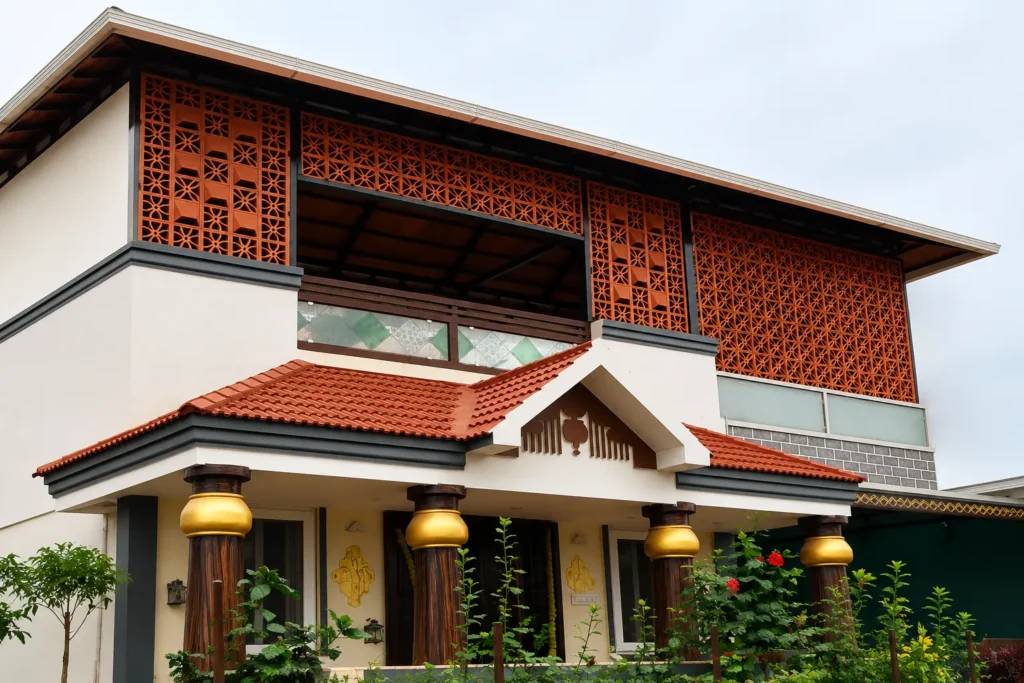
Are Clay Roofing Tiles Good for Kerala?
” Clay roofing tiles work well in Kerala only when slope, overlap, ridge, and gutter details are correct.”
Yes, clay roofing tiles are good for Kerala because they are suitable for sloped roofs and water shedding. They also match many traditional Kerala home designs.
But the tile alone is not enough. Poor overlap, weak battens, wrong slope, or bad ridge work can still cause leakage. If you choose clay tiles, ask the contractor how water will move from the ridge to the gutter during heavy rain.
Clay tiles are also practical because replacement pieces are usually easier to find than rare imported-style tiles. This matters in Kerala homes where falling branches, clogged gutters, or storm damage can create small roof repairs after monsoon.
Are Terracotta Tiles Better Than Concrete Tiles?
” Terracotta tiles suit heat comfort and appearance, while concrete tiles need a confirmed roof-load check.”
Terracotta tiles are usually better for Kerala homes where heat comfort, natural finish, and appearance matter. They look warm, suit tropical home designs, and work well on sloped roofs when installed properly.
Concrete tiles may cost less in some projects, but they are heavy and need careful structural planning. If your home already has an old roof frame, do not switch to heavy concrete tiles without a roof load check.
The better choice depends on your priority. For appearance and heat comfort, terracotta is usually stronger. For budget and availability, concrete may be considered, but only after checking structure and drainage.
Are Cool Roof Tiles Good in Kerala?
” Cool roof tiles help terraces and hot top floors, but cleaning and ventilation decide long-term performance.”
Yes, cool roof tiles are useful in Kerala, especially for terraces and hot top floors. Cool roof surfaces reflect more sunlight and absorb less heat than darker surfaces, which can improve indoor comfort.
They are most useful in hotter areas and exposed homes. For example, a house in Palakkad or a top-floor home in Kochi may benefit more from cool roof tiles than a shaded sloped-roof house in a highland area.
But cool roof tiles are not fit-and-forget. Dust, algae, and black stains can reduce their effect. If the roof is hard to access for cleaning, the long-term benefit may reduce.
For better heat control, combine cool roof tiles with ventilation, ceiling insulation, and shade.
Which Roof Tile Is Best for Coastal Kerala?
” Coastal Kerala roofs need moisture-safe tiles, anti-rust fittings, gutter access, and algae cleaning plans.”
For coastal Kerala areas like Kochi, Alappuzha, Kollam, Kozhikode, and Kannur, choose tiles and fittings that tolerate moisture, algae, and salt air.
In coastal homes, the tile is only one part of the decision. You should also check:
- Ridge sealing
- Gutter size
- Anti-rust fittings
- Algae cleaning access
- Wall-junction waterproofing
- Replacement tile availability
A glossy or decorative tile may look attractive, but if it becomes slippery and hard to clean, it may not be practical near the sea. Coastal homes need roofing materials that can be maintained safely.
Which Roof Tile Is Best for Heat Reduction?
“Heat reduction works best when roof tile, ventilation, insulation, shade, and colour are planned together.”
For heat reduction, terracotta tiles, clay roofing tiles, and light-coloured cool roof tiles are good options. Cool roof tiles are especially useful on terraces and exposed top floors.
But roof tile alone cannot solve every heat problem. In hot areas like Palakkad, also check:
- Attic ventilation
- Ceiling insulation
- Shade from nearby trees or roof extensions
- Light-coloured roof surfaces
- Air movement inside the house
If the roof traps hot air, even a good tile may not give enough comfort. Heat reduction works best when tile, ventilation, and insulation are planned together.
Common Mistakes When Choosing Roofing Tiles in Kerala
” Most roof tile failures in Kerala come from poor detailing, not the tile alone.”
Most roof tile failures come from poor detailing, not only poor tile quality.
Common mistakes Kerala homeowners should avoid:
- Choosing tiles only by colour.
- Buying heavy tiles without checking roof strength.
- Ignoring roof slope.
- Not asking about tile overlap.
- Forgetting ridge, valley, gutter, and flashing details.
- Not keeping spare tiles for future repair.
- Choosing very cheap tiles without checking breakage risk.
- Hiring installers who cannot show previous local work.
- Ignoring trees that drop leaves into gutters.
- Using the same tile choice for sloped roofs and flat terraces.
- Comparing tile cost without transport, labour, ridge pieces, and wastage.
- Choosing rare imported-looking tiles without checking future replacement stock.
Local detail: Coconut leaves, mango leaves, jackfruit leaves, and rubber plantation debris can block roof gutters quickly during monsoon.
Red flag: If the seller talks only about colour and price but not slope, weight, water exit, and replacement stock, pause before buying.
A Simple Field Test Before Buying Roof Tiles
“A seven-day sample tile test can reveal cracks, finish issues, colour change, and water-related concerns.”
Before ordering roof tiles, ask the supplier for three sample tiles. Keep them outside for seven days. Pour around two litres of water over each tile. Check for cracks, edge quality, bending, surface finish, colour change, and weight difference. Take photos with the supplier name and date.
A practical Kerala field note: In many homes, the problem is not always the tile. It is water exit. In one local-style sloped roof review, the clay tiles were still usable, but the gutter path was narrow and filled with leaves after rain. Damp patches appeared near the wall junction.
Replacing all tiles would not have solved the issue unless the gutter and wall-junction work were corrected.
This is why homeowners should inspect the full roof system, not just the tile sample.
Unpopular truth: A beautiful showroom tile may become a headache if spare pieces are hard to find after two years.
Checklist Before Buying Roofing Tiles in Kerala
“Before buying, compare total roof cost, not only tile price per piece or square foot.”
Do this before paying an advance:
- Step 1: Confirm whether your roof is sloped or flat.
- Step 2: Ask your contractor whether the roof frame can carry heavy tiles.
- Step 3: Request tile size, material, warranty terms, and water-resistance claims.
- Step 4: Check if ridge tiles, side tiles, and spare tiles are available.
- Step 5: Visit at least one completed local project using the same tile.
- Step 6: Compare total cost, including labour, battens, gutters, ridge work, transport, and wastage.
- Step 7: Ask whether the same tile will be available for future repairs.
Proof you keep: Supplier quote, sample tile photo, project reference, roof slope note, and date.
Checklist Before Roof Tile Installation
“ Before installation, confirm batten spacing, overlap, water exit points, ridge, valley, and gutter plans.”
Do this before installation starts:
- Step 1: Confirm batten spacing and tile overlap.
- Step 2: Mark water exit points before laying tiles.
- Step 3: Check ridge, valley, gutter, and wall-junction plans.
- Step 4: Keep spare tiles at the site.
- Step 5: Photograph all roof sides before scaffolding is removed.
- Step 6: Ask for a post-monsoon inspection date.
- Step 7: Confirm who is responsible if leakage starts after the first rain.
Proof you keep: Site photos, invoice, batch details, installer checklist, and date.
Myth vs Fact About Roofing Tiles in Kerala
“Expensive tiles do not guarantee a leak-free roof; installation quality matters just as much.”
| Myth | Fact |
|---|---|
| The most expensive roof tile is always the best. | The best tile depends on roof slope, structure, weather, labour quality, and maintenance. |
| Clay tiles never leak. | Clay tiles can leak if overlap, ridge work, or gutter planning is poor. |
| Cool roof tiles solve every heat problem. | They help, but ventilation, insulation, shade, and cleaning also matter. |
| Concrete roof tiles are always bad. | They can work when the roof structure is designed for their weight. |
| A roof tile warranty means the roof will not leak. | Tile warranty and installation quality are separate issues. |
| Imported-looking tiles are better than local-style tiles. | A local-style tile with easy replacement stock can be more practical for Kerala homes. |
Paying more for tile quality can reduce breakage risk, but paying for a skilled installer may protect the roof more than upgrading only the tile.
FAQs
Which are the best roofing tiles in Kerala?
Clay roofing tiles and terracotta tiles are the best all-round choices for many sloped Kerala homes. They suit the climate, match local architecture, and are easier to repair than many unusual imported styles. For flat terraces or top-floor heat, cool roof tiles may be better.
Are clay roof tiles good for Kerala rain?
Yes, clay roof tiles can work well in Kerala rain when the roof has proper slope, overlap, ridge work, and gutters. The tile must be part of a proper roof system. Weak installation can cause leaks even when the tile is good.
. Which roof tile keeps a Kerala house cooler?
Terracotta, clay, and light-coloured cool roof tiles are good options. Cool roof tiles are especially useful for terraces and hot top floors. For better results, combine the right tile with ventilation, insulation, and shade.
Are concrete roof tiles suitable in Kerala?
Concrete roof tiles can be suitable if the structure is designed for their weight and the installation is done properly. They are not automatically a poor choice, but they need careful load and drainage checks.
What is the biggest mistake when choosing roof tiles?
The biggest mistake is choosing by colour or price alone. In Kerala, roof slope, overlap, gutters, ridge work, and installer skill often decide whether the roof stays dry.
Should I choose branded roof tiles?
A known brand can help with consistency and replacement availability. Still, ask for tile specifications, local project references, spare tile availability, and written installation details.
Final Takeaway
Choosing the best roofing tiles in Kerala becomes easier when you know your roof slope, structure, budget, and local weather conditions. Before buying tiles, compare clay, terracotta, concrete, and cool roof tile options based on your home’s actual needs.
If you are planning a new roof or replacing old tiles, speak with a roofing expert before finalising the material. A proper site check can help you avoid leakage, heat build-up, poor drainage, and extra repair costs later.